sanjay begins to correctly graph the function $f(x) = (x + 1)^2 - 3$. based on the axis of symmetry and the…
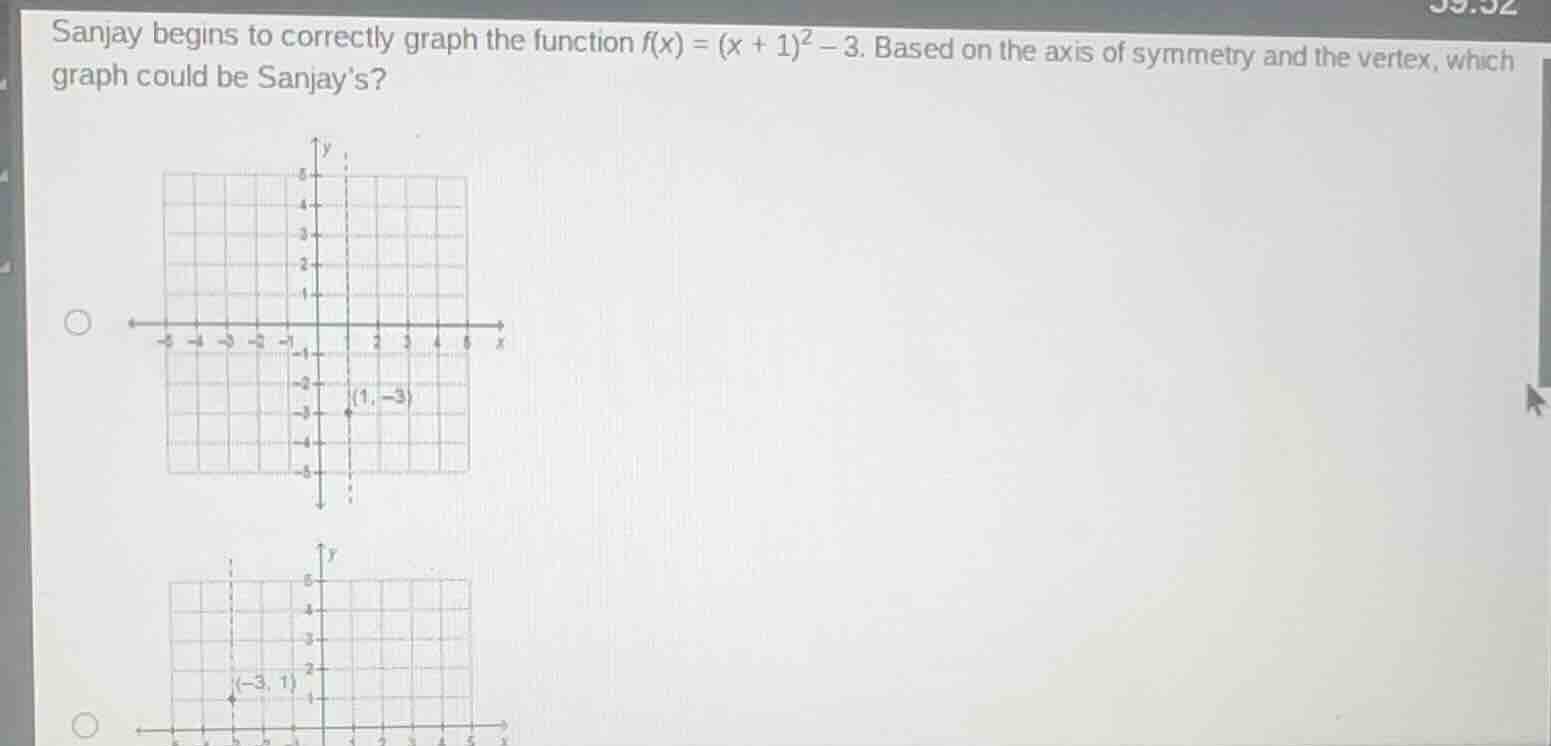
sanjay begins to correctly graph the function $f(x) = (x + 1)^2 - 3$. based on the axis of symmetry and the vertex, which graph could be sanjays?
Answer
Explanation:
Step1: Identify the vertex form of the function
The given function is $f(x) = (x + 1)^{2} - 3$, which is in the vertex form $f(x) = a(x - h)^{2} + k$.
Step2: Determine the vertex $(h, k)$
Comparing $f(x) = (x - (-1))^{2} + (-3)$ to the vertex form, we find $h = -1$ and $k = -3$. $$Vertex = (-1, -3)$$
Step3: Identify the axis of symmetry
The axis of symmetry for a parabola in vertex form is the vertical line passing through the x-coordinate of the vertex. $$x = h \Rightarrow x = -1$$
Step4: Match with the provided graphs
The correct graph must show a vertex at $(-1, -3)$ and a dashed vertical line (axis of symmetry) at $x = -1$. Looking at the options, the first graph shows a vertex at $(1, -3)$ and the second shows a vertex at $(-3, 1)$, neither of which match. However, based on the mathematical derivation, we seek the graph with vertex $(-1, -3)$.
Answer:
The correct graph is the one that displays the vertex at $(-1, -3)$ and the axis of symmetry at $x = -1$.