scarlett received the following problem: a particle moves in a straight line with velocity v(t)=2t + 5…
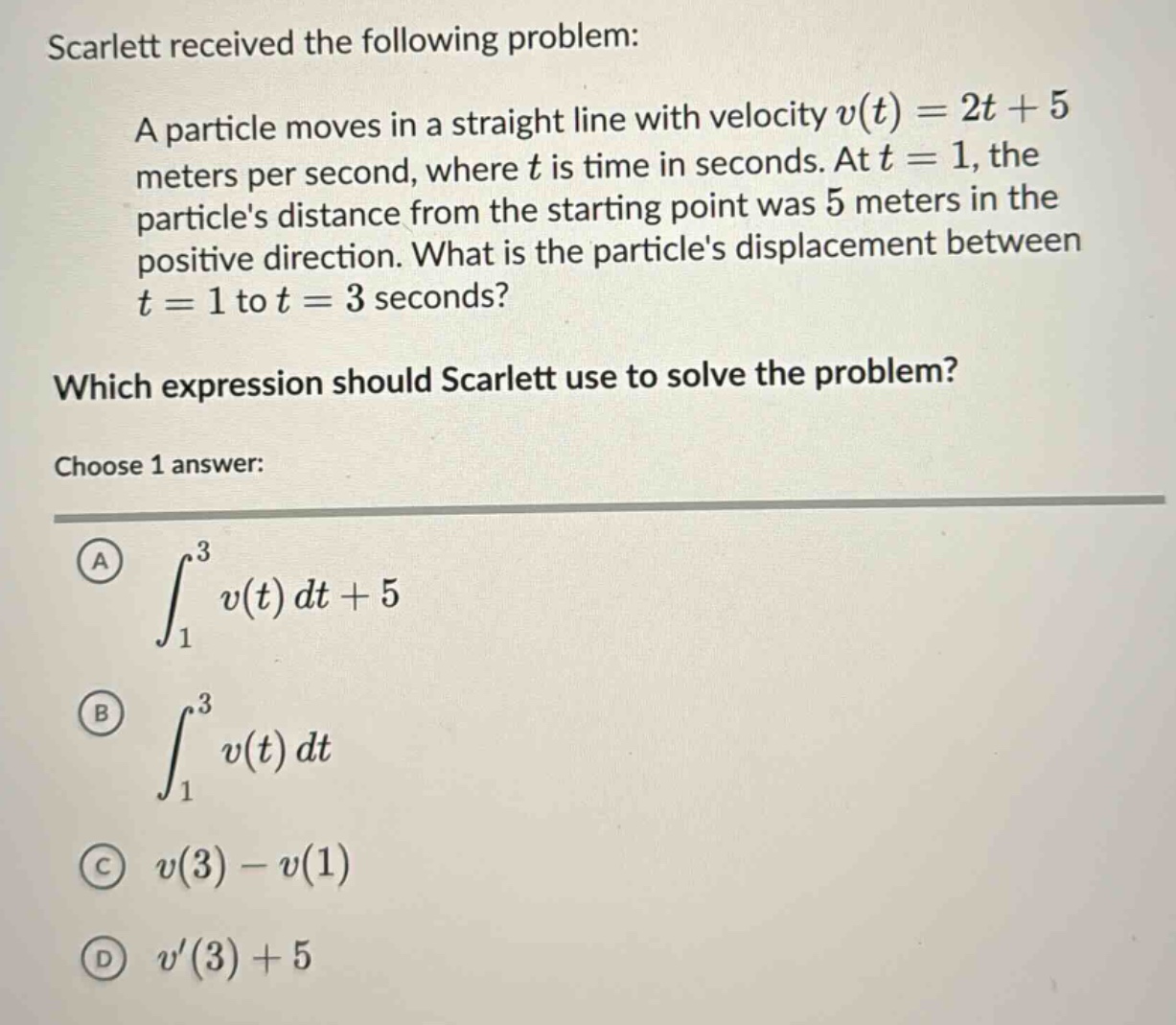
scarlett received the following problem: a particle moves in a straight line with velocity v(t)=2t + 5 meters per second, where t is time in seconds. at t = 1, the particles distance from the starting point was 5 meters in the positive direction. what is the particles displacement between t = 1 to t = 3 seconds? which expression should scarlett use to solve the problem? choose 1 answer: a ∫₁³ v(t)dt + 5 b ∫₁³ v(t)dt c v(3)-v(1) d v(3)+5
Answer
Explanation:
Step1: Recall displacement - velocity relation
Displacement $s$ over an interval $[a,b]$ is given by $\int_{a}^{b}v(t)dt$, where $v(t)$ is the velocity - function. Here, we want to find the displacement of the particle from $t = 1$ to $t=3$. The initial position at $t = 1$ is not relevant when calculating the displacement over the interval $[1,3]$.
Step2: Identify the correct expression
The displacement of the particle from $t = 1$ to $t = 3$ is given by $\int_{1}^{3}v(t)dt$.
Answer:
B. $\int_{1}^{3}v(t)dt$