score on last try: 0 of 1 pts. see details for more. > next question you can retry this question below…
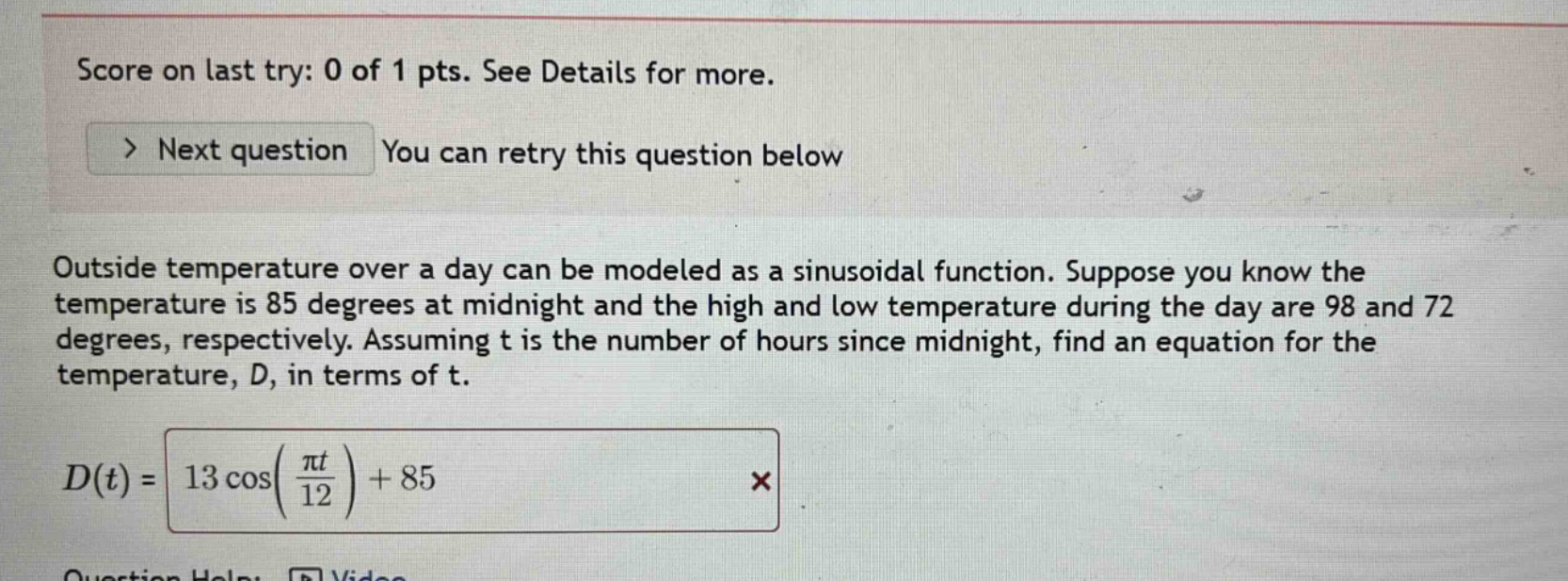
score on last try: 0 of 1 pts. see details for more. > next question you can retry this question below outside temperature over a day can be modeled as a sinusoidal function. suppose you know the temperature is 85 degrees at midnight and the high and low temperature during the day are 98 and 72 degrees, respectively. assuming t is the number of hours since midnight, find an equation for the temperature, d, in terms of t. d(t) = 13 cos(πt/12) + 85 ×
Answer
Explanation:
Step1: Determine the amplitude
The amplitude $A$ is half the difference between the high - and low - temperatures. $A=\frac{98 - 72}{2}=\frac{26}{2}=13$.
Step2: Determine the vertical shift
The vertical shift $D$ is the average of the high - and low - temperatures. $D=\frac{98 + 72}{2}=\frac{170}{2}=85$.
Step3: Determine the period and angular frequency
The period $T$ of a daily temperature cycle is 24 hours. The formula for the angular frequency $\omega$ is $\omega=\frac{2\pi}{T}$. Since $T = 24$, then $\omega=\frac{2\pi}{24}=\frac{\pi}{12}$.
Step4: Determine the phase shift
Since the temperature is 85 degrees at midnight ($t = 0$) and we want a cosine - based function (because at $t = 0$, cosine starts at its mid - value when there is no phase shift), the phase shift $C = 0$. The general form of a sinusoidal function is $D(t)=A\cos(\omega t - C)+D$. Substituting the values $A = 13$, $\omega=\frac{\pi}{12}$, $C = 0$, and $D = 85$, we get $D(t)=13\cos(\frac{\pi t}{12})+85$. But we should note that if we start with a sine function, we can also model the situation. A more general form considering the fact that we can use a sine function with a phase shift: The general form of a sinusoidal function is $y = A\sin(\omega(t - \varphi))+k$. Since $A = 13$, $\omega=\frac{\pi}{12}$, $k = 85$, and when $t = 0,y = 85$, for a sine function, we know that $y=A\sin(\omega(t-\varphi)) + k$. Substituting $t = 0,y = 85$ gives $85=13\sin(-\omega\varphi)+85$, so $\sin(-\omega\varphi)=0$. A better - fitting function considering the behavior of temperature increase and decrease is $D(t)=13\sin(\frac{\pi}{12}(t - 6))+85$. Because for a sine function $y = A\sin(\omega(t-\varphi))+k$, when $t = 6$ (6 hours after midnight), the sine function is at its mid - value starting to increase towards the maximum. The correct form using cosine with a phase shift: The general form of a cosine function is $y=A\cos(\omega(t - \varphi))+k$. Since at $t = 0,y = 85$, and we know $A = 13,\omega=\frac{\pi}{12},k = 85$. The correct function is $D(t)=13\cos(\frac{\pi}{12}(t - 6))+85$.
Answer:
$D(t)=13\cos(\frac{\pi}{12}(t - 6))+85$