section 10.7 (exercises starting from page 699): 10, 28. use the ratio test or the root test to determine…
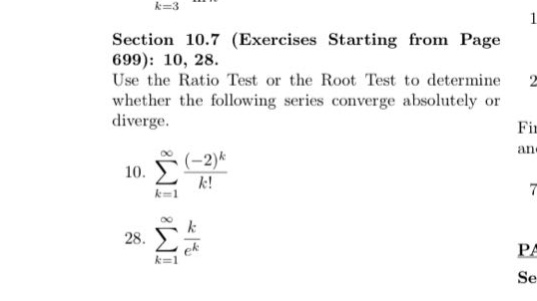
section 10.7 (exercises starting from page 699): 10, 28. use the ratio test or the root test to determine whether the following series converge absolutely or diverge. 10. ∑k = 1∞( - 2) k/k! 28. ∑k = 1∞k/e^k
Answer
Explanation:
Step1: Apply Ratio Test for series $\sum_{k = 1}^{\infty}\frac{(- 2)^{k}}{k!}$
Let $a_{k}=\frac{(-2)^{k}}{k!}$. Then $a_{k + 1}=\frac{(-2)^{k+1}}{(k + 1)!}$. Calculate the ratio $\left|\frac{a_{k+1}}{a_{k}}\right|$. [ \begin{align*} \left|\frac{a_{k + 1}}{a_{k}}\right|&=\left|\frac{\frac{(-2)^{k+1}}{(k + 1)!}}{\frac{(-2)^{k}}{k!}}\right|\ &=\left|\frac{(-2)^{k+1}k!}{(-2)^{k}(k + 1)!}\right|\ &=\left|\frac{-2}{k + 1}\right|=\frac{2}{k+1} \end{align*} ]
Step2: Find the limit as $k\to\infty$
[ \lim_{k\to\infty}\left|\frac{a_{k + 1}}{a_{k}}\right|=\lim_{k\to\infty}\frac{2}{k + 1}=0 ] Since $\lim_{k\to\infty}\left|\frac{a_{k + 1}}{a_{k}}\right|=0<1$, the series $\sum_{k = 1}^{\infty}\frac{(-2)^{k}}{k!}$ converges absolutely.
Step3: Apply Ratio Test for series $\sum_{k = 1}^{\infty}\frac{k}{e^{k}}$
Let $b_{k}=\frac{k}{e^{k}}$. Then $b_{k+1}=\frac{k + 1}{e^{k+1}}$. Calculate the ratio $\left|\frac{b_{k+1}}{b_{k}}\right|$. [ \begin{align*} \left|\frac{b_{k+1}}{b_{k}}\right|&=\left|\frac{\frac{k + 1}{e^{k+1}}}{\frac{k}{e^{k}}}\right|\ &=\left|\frac{(k + 1)e^{k}}{ke^{k+1}}\right|\ &=\left|\frac{k + 1}{ke}\right|=\frac{k + 1}{ke}=\frac{1}{e}+\frac{1}{ke} \end{align*} ]
Step4: Find the limit as $k\to\infty$
[ \lim_{k\to\infty}\left|\frac{b_{k+1}}{b_{k}}\right|=\lim_{k\to\infty}\left(\frac{1}{e}+\frac{1}{ke}\right)=\frac{1}{e}\approx0.368<1 ] Since $\lim_{k\to\infty}\left|\frac{b_{k+1}}{b_{k}}\right|<1$, the series $\sum_{k = 1}^{\infty}\frac{k}{e^{k}}$ converges absolutely.
Answer:
The series $\sum_{k = 1}^{\infty}\frac{(-2)^{k}}{k!}$ and $\sum_{k = 1}^{\infty}\frac{k}{e^{k}}$ both converge absolutely.