select the correct answer. consider function $f$. $f(x)=\begin{cases}2^{x},&x < 0\\-x^{2}-4x + 1,&0 < x <…
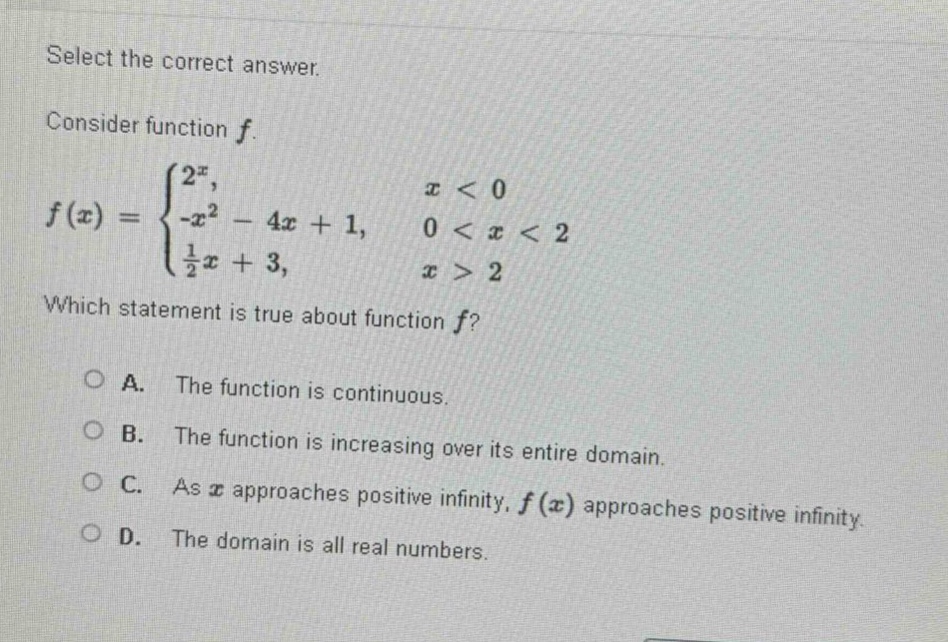
select the correct answer. consider function $f$. $f(x)=\begin{cases}2^{x},&x < 0\\-x^{2}-4x + 1,&0 < x < 2\\\frac{1}{2}x + 3,&x>2end{cases}$ which statement is true about function $f$? a. the function is continuous. b. the function is increasing over its entire domain. c. as $x$ approaches positive infinity, $f(x)$ approaches positive infinity. d. the domain is all real numbers.
Answer
Explanation:
Step1: Analyze the domain
The function is not defined at (x = 0) and (x=2), so the domain is not all real - numbers. So option D is incorrect.
Step2: Analyze continuity
Check the limits at (x = 0) and (x = 2). Left - hand limit as (x\to0^{-}): (\lim_{x\to0^{-}}f(x)=\lim_{x\to0^{-}}2^{x}=1) Right - hand limit as (x\to0^{+}): (\lim_{x\to0^{+}}f(x)=\lim_{x\to0^{+}}(-x^{2}-4x + 1)=1) But the function is not defined at (x = 0). Also, check at (x = 2). Left - hand limit as (x\to2^{-}): (\lim_{x\to2^{-}}f(x)=\lim_{x\to2^{-}}(-x^{2}-4x + 1)=-4-8 + 1=-11) Right - hand limit as (x\to2^{+}): (\lim_{x\to2^{+}}f(x)=\lim_{x\to2^{+}}(\frac{1}{2}x + 3)=\frac{1}{2}\times2+3=4) The function is not continuous, so option A is incorrect.
Step3: Analyze monotonicity
For (y = 2^{x},x\lt0), it is increasing. For (y=-x^{2}-4x + 1=-(x + 2)^{2}+5,0\lt x\lt2), its derivative (y^\prime=-2x - 4\lt0) for (0\lt x\lt2), it is decreasing. So the function is not increasing over its entire domain, option B is incorrect.
Step4: Analyze the limit as (x\to+\infty)
As (x\to+\infty), (f(x)=\frac{1}{2}x + 3). Since the coefficient of (x) is (\frac{1}{2}\gt0), (\lim_{x\to+\infty}f(x)=+\infty).
Answer:
C. As (x) approaches positive infinity, (f(x)) approaches positive infinity.