2 select the correct answer. consider functions f and g. f(x)=x³ + 5x² - x which statement is true about…
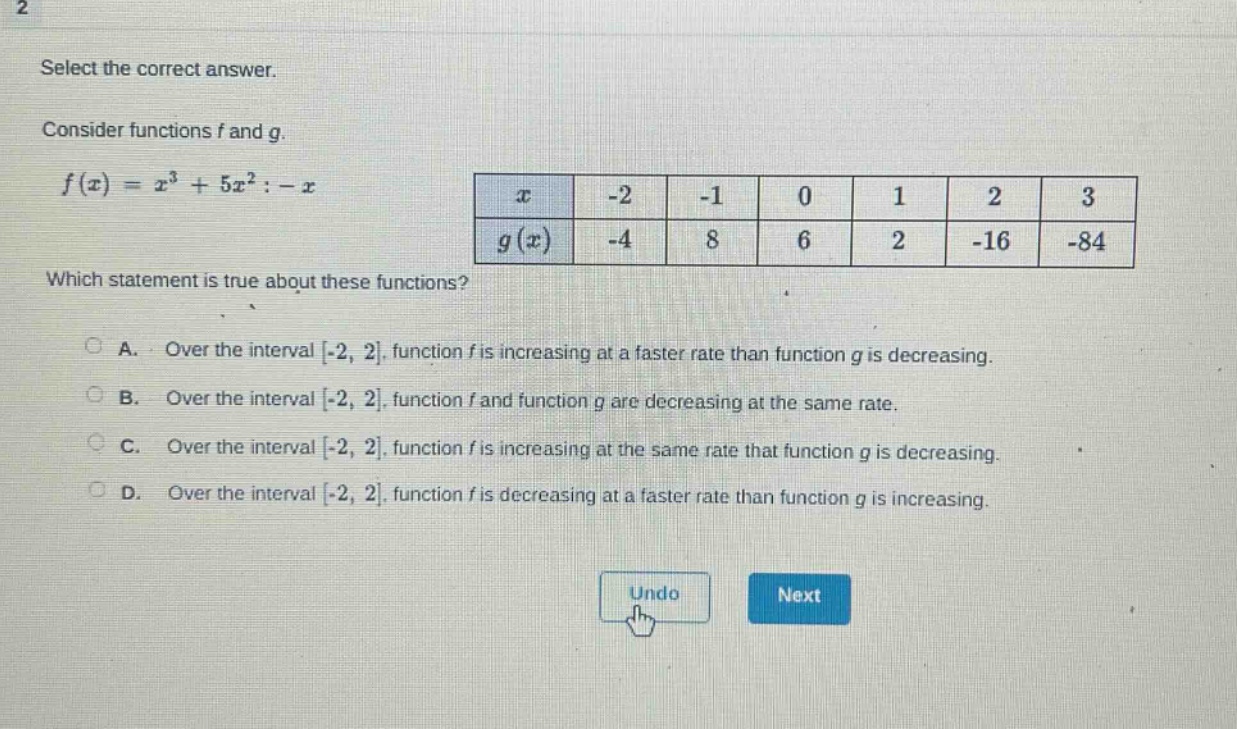
2 select the correct answer. consider functions f and g. f(x)=x³ + 5x² - x which statement is true about these functions? a. over the interval -2, 2, function f is increasing at a faster rate than function g is decreasing. b. over the interval -2, 2, function f and function g are decreasing at the same rate. c. over the interval -2, 2, function f is increasing at the same rate that function g is decreasing. d. over the interval -2, 2, function f is decreasing at a faster rate than function g is increasing. x -2 -1 0 1 2 3 g(x) -4 8 6 2 -16 -84
Answer
Explanation:
Step1: Find the rate - of - change of function (f(x)) over ([-2,2])
The average rate of change of a function (y = f(x)) over the interval ([a,b]) is given by (\frac{f(b)-f(a)}{b - a}). For (f(x)=x^{3}+5x^{2}-x), (a=-2) and (b = 2). First, find (f(-2)) and (f(2)): [ \begin{align*} f(-2)&=(-2)^{3}+5\times(-2)^{2}-(-2)\ &=-8 + 20+2\ &=14 \end{align*} ] [ \begin{align*} f(2)&=2^{3}+5\times2^{2}-2\ &=8 + 20-2\ &=26 \end{align*} ] The average rate of change of (f(x)) over ([-2,2]) is (\frac{f(2)-f(-2)}{2-(-2)}=\frac{26 - 14}{4}=\frac{12}{4}=3).
Step2: Find the rate - of change of function (g(x)) over ([-2,2])
From the table, when (x=-2), (g(-2)=-4) and when (x = 2), (g(2)=-16). The average rate of change of (g(x)) over ([-2,2]) is (\frac{g(2)-g(-2)}{2-(-2)}=\frac{-16-(-4)}{4}=\frac{-16 + 4}{4}=\frac{-12}{4}=-3). The magnitude of the rate of change of (g(x)) is (3).
Answer:
C. Over the interval ([-2,2]), function (f) is increasing at the same rate that function (g) is decreasing.