select the correct answer. consider the functions f and g in the tables below. f(x)=90x² + 180x + 92 x y 0…
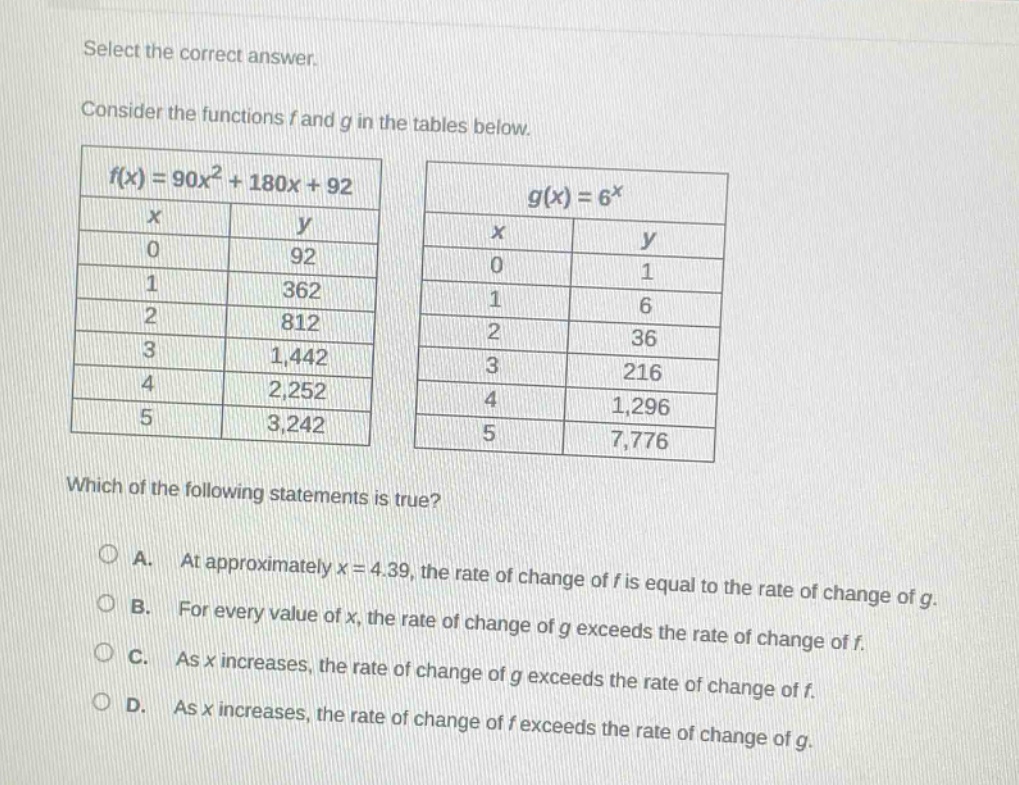
select the correct answer. consider the functions f and g in the tables below. f(x)=90x² + 180x + 92 x y 0 92 1 362 2 812 3 1,442 4 2,252 5 3,242 g(x)=6^x x y 0 1 1 6 2 36 3 216 4 1,296 5 7,776 which of the following statements is true? a. at approximately x = 4.39, the rate of change of f is equal to the rate of change of g. b. for every value of x, the rate of change of g exceeds the rate of change of f. c. as x increases, the rate of change of g exceeds the rate of change of f. d. as x increases, the rate of change of f exceeds the rate of change of g.
Answer
Explanation:
Step1: Recall rate - of - change concept
The rate of change of a function can be analyzed by looking at how the function values change as the input changes. For a non - linear function, we can consider the general behavior. A quadratic function $y = ax^{2}+bx + c$ ($a\neq0$) has a second - degree polynomial form, and an exponential function $y = a^{x}$ ($a>1$) has an exponential growth form. Here, $f(x)=90x^{2}+180x + 92$ is a quadratic function ($a = 90$, $b = 180$, $c = 92$) and $g(x)=6^{x}$ is an exponential function with $a = 6>1$.
Step2: Analyze the growth behavior of quadratic and exponential functions
The rate of change of a quadratic function $y=ax^{2}+bx + c$ is given by its derivative $y^\prime=2ax + b$. The rate of change of an exponential function $y = a^{x}$ is given by its derivative $y^\prime=a^{x}\ln(a)$. For the quadratic function $f(x)=90x^{2}+180x + 92$, $f^\prime(x)=180x + 180$. For the exponential function $g(x)=6^{x}$, $g^\prime(x)=6^{x}\ln(6)$. At small values of $x$, the rate of change of the quadratic function $f(x)$ may be larger than that of the exponential function $g(x)$. But as $x$ increases, the exponential function $y = a^{x}$ with $a>1$ will always out - grow any polynomial function.
Step3: Evaluate each option
- Option A: There is no indication or calculation shown that at $x = 4.39$ the rates of change are equal.
- Option B: For small values of $x$, the rate of change of $f(x)$ is larger than that of $g(x)$. For example, when $x = 0$, $f^\prime(0)=180$ and $g^\prime(0)=\ln(6)\approx1.79$.
- Option C: As $x$ increases, the exponential function $g(x)=6^{x}$ has a rate of change $g^\prime(x)=6^{x}\ln(6)$ which will eventually exceed the rate of change of the quadratic function $f(x)$ whose rate of change is $f^\prime(x)=180x + 180$. This is because exponential growth ($y = a^{x},a>1$) out - paces polynomial growth.
- Option D: This is incorrect because of the nature of exponential growth compared to polynomial growth.
Answer:
C. As x increases, the rate of change of g exceeds the rate of change of f.