select the correct answer. consider the functions f and g in the tables below. f(x)=90x² + 180x + 92…
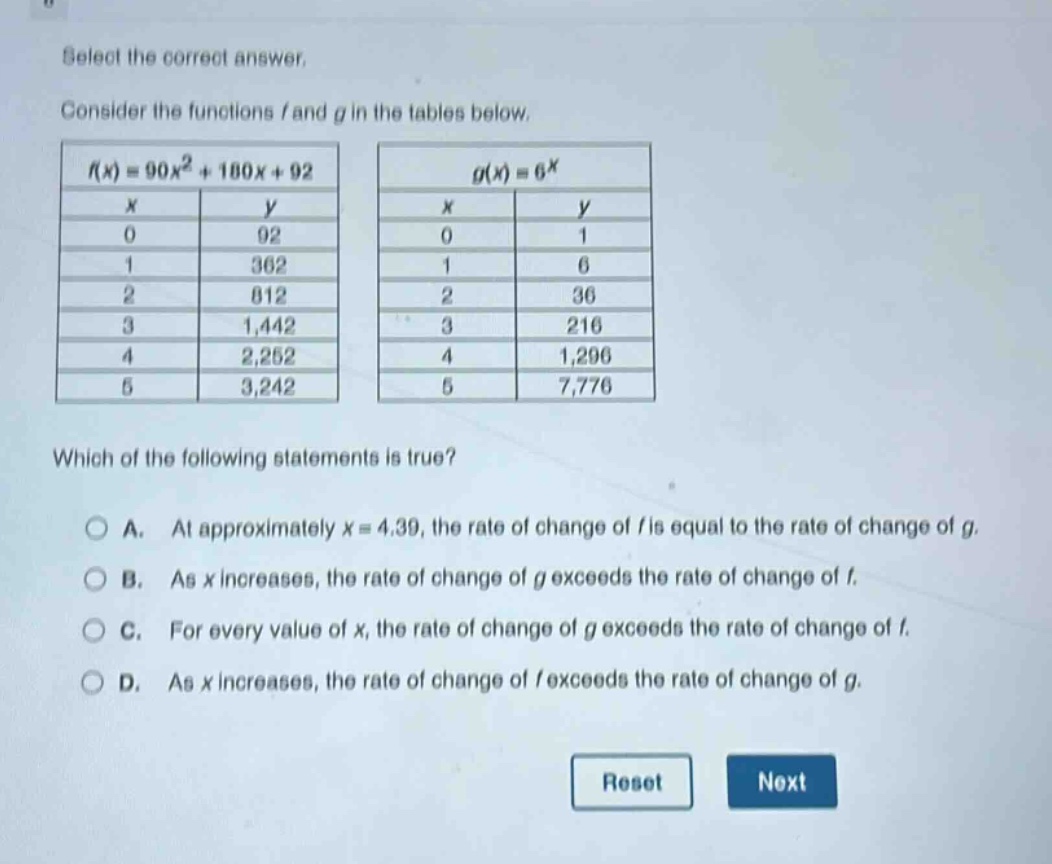
select the correct answer. consider the functions f and g in the tables below. f(x)=90x² + 180x + 92 g(x)=6^x x y x y 0 92 0 1 1 362 1 6 2 812 2 36 3 1,442 3 216 4 2,252 4 1,296 5 3,242 5 7,776 which of the following statements is true? a. at approximately x = 4.39, the rate of change of f is equal to the rate of change of g. b. as x increases, the rate of change of g exceeds the rate of change of f. c. for every value of x, the rate of change of g exceeds the rate of change of f. d. as x increases, the rate of change of f exceeds the rate of change of g. reset next
Answer
Explanation:
Step1: Recall rate - of - change concept
The rate of change of a function (y = f(x)) is given by its derivative. For (f(x)=90x^{2}+180x + 92), using the power rule ((x^{n})^\prime=nx^{n - 1}), we have (f^\prime(x)=180x + 180). For (g(x)=6^{x}), using the rule ((a^{x})^\prime=a^{x}\ln a), we have (g^\prime(x)=6^{x}\ln6\approx1.792\times6^{x}).
Step2: Analyze the behavior of the derivatives as (x) increases
Let's check the values of the derivatives for some (x) values. When (x = 0), (f^\prime(0)=180\times0 + 180=180) and (g^\prime(0)=6^{0}\ln6=\ln6\approx1.792). Here (f^\prime(0)>g^\prime(0)). As (x) increases, we know that (f^\prime(x)) is a linear function ((y = 180x+180)) and (g^\prime(x)) is an exponential function ((y = 1.792\times6^{x})). Exponential functions (y = a\cdot b^{x}) ((a>0,b > 1)) grow faster than linear functions (y=mx + c) ((m>0,c>0)) as (x) increases. So, as (x) increases, the rate of change of (g) exceeds the rate of change of (f).
Answer:
B. As (x) increases, the rate of change of (g) exceeds the rate of change of (f).