select the correct answer. consider the functions f and g in the tables below. f(x)=90x² + 180x + 92…
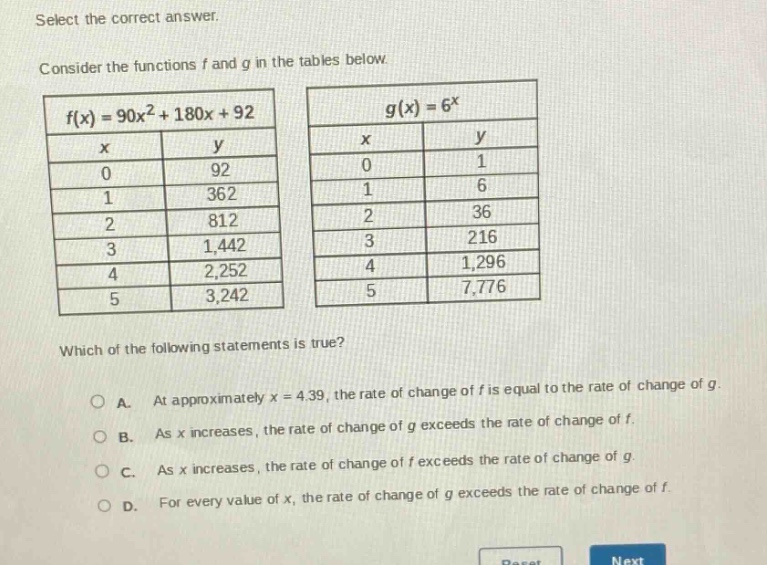
select the correct answer. consider the functions f and g in the tables below. f(x)=90x² + 180x + 92 g(x)=6^x x y x y 0 92 0 1 1 362 1 6 2 812 2 36 3 1,442 3 216 4 2,252 4 1,296 5 3,242 5 7,776 which of the following statements is true? a. at approximately x = 4.39, the rate of change of f is equal to the rate of change of g. b. as x increases, the rate of change of g exceeds the rate of change of f. c. as x increases, the rate of change of f exceeds the rate of change of g. d. for every value of x, the rate of change of g exceeds the rate of change of f.
Answer
Answer:
B. As x increases, the rate of change of g exceeds the rate of change of f.
Explanation:
Step1: Recall rate - of - change concept
The rate of change of a function can be approximated by looking at differences in y - values for equal intervals of x.
Step2: Analyze f(x)
For (f(x)=90x^{2}+180x + 92), the differences in y - values between consecutive x - values are: When (x = 0,y = 92); when (x = 1,y = 362), difference (=362 - 92=270); when (x = 2,y = 812), difference (=812 - 362 = 450); when (x = 3,y = 1442), difference (=1442 - 812=630); when (x = 4,y = 2252), difference (=2252 - 1442 = 810); when (x = 5,y = 3242), difference (=3242 - 2252=990). The differences are increasing, but they are quadratic - like.
Step3: Analyze g(x)
For (g(x)=6^{x}), when (x = 0,y = 1); when (x = 1,y = 6), difference (=6 - 1 = 5); when (x = 2,y = 36), difference (=36 - 6=30); when (x = 3,y = 216), difference (=216 - 36 = 180); when (x = 4,y = 1296), difference (=1296 - 216 = 1080); when (x = 5,y = 7776), difference (=7776 - 1296=6480). The differences for (g(x)) are growing exponentially.
Step4: Compare rates of change
As x increases, the exponential function (g(x)=6^{x}) will have a rate of change that exceeds the rate of change of the quadratic function (f(x)=90x^{2}+180x + 92). There is no indication that the rates of change are equal at (x = 4.39), and for small x - values, the rate of change of f can be larger than that of g. So, as x increases, the rate of change of g exceeds the rate of change of f.