select the correct answer. consider the graph of the function f(x) = ln x. which is a feature of function g…
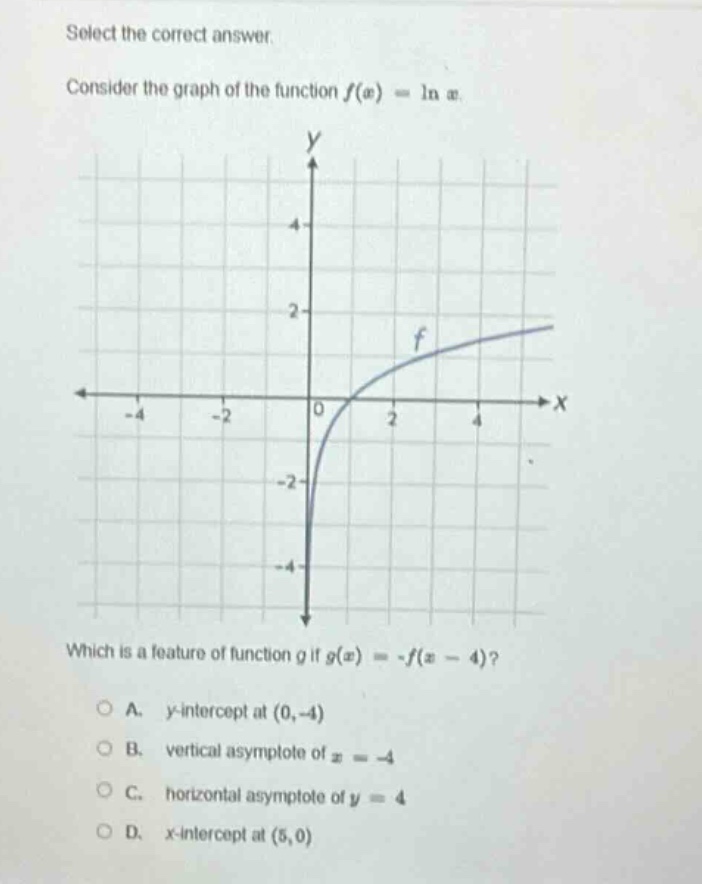
select the correct answer. consider the graph of the function f(x) = ln x. which is a feature of function g if g(x)= -f(x - 4)? a. y - intercept at (0,-4) b. vertical asymptote of x = -4 c. horizontal asymptote of y = 4 d. x - intercept at (5,0)
Answer
Explanation:
Step1: First find the expression of (g(x))
Given (f(x)=\ln x), then (g(x)=-f(x - 4)=-\ln(x - 4)).
Step2: Analyze the y - intercept
Set (x = 0) in (g(x)), but for (g(x)=-\ln(x - 4)), when (x = 0), (x-4=-4<0) and the natural - logarithm (\ln(x - 4)) is undefined in the real - number system, so there is no y - intercept.
Step3: Analyze the vertical asymptote
The domain of (y = \ln u) is (u>0). For (g(x)=-\ln(x - 4)), set (x-4>0), the vertical asymptote is (x = 4) (since (\lim_{x\rightarrow4^{+}}\ln(x - 4)=-\infty) and (\lim_{x\rightarrow4^{+}}g(x)=\infty)).
Step4: Analyze the horizontal asymptote
As (x\rightarrow+\infty), (\lim_{x\rightarrow+\infty}\ln(x - 4)=+\infty), so (\lim_{x\rightarrow+\infty}g(x)=-\infty), there is no horizontal asymptote.
Step5: Analyze the x - intercept
Set (g(x)=0), then (-\ln(x - 4)=0), which means (\ln(x - 4)=0). Since (\ln1 = 0), we have (x-4 = 1), so (x=5). The x - intercept is at the point ((5,0)).
Answer:
D. (x)-intercept at ((5,0))