select the correct answer from each drop - down menu. consider function f, where b is a real number…
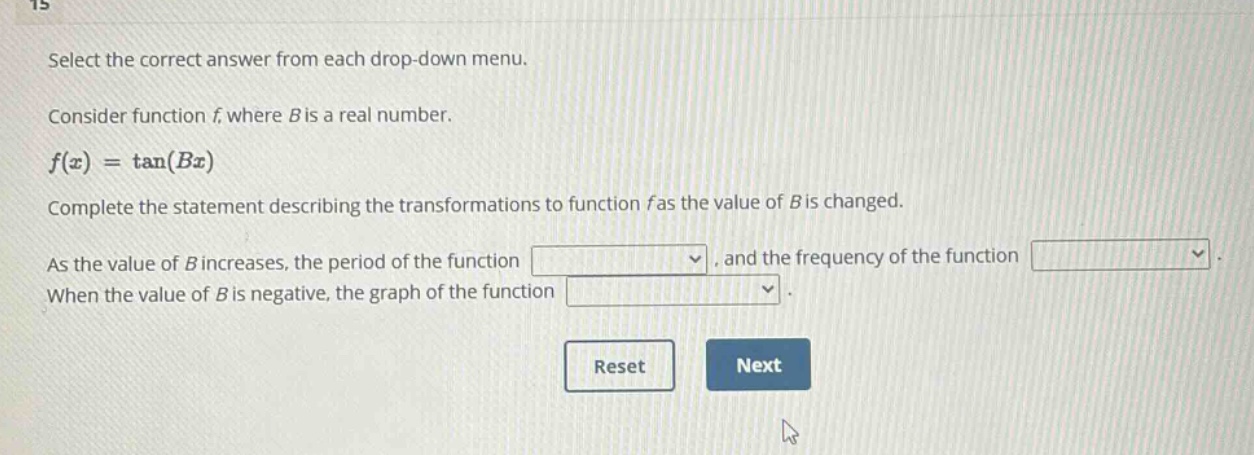
select the correct answer from each drop - down menu. consider function f, where b is a real number. $f(x)=\tan(bx)$ complete the statement describing the transformations to function f as the value of b is changed. as the value of b increases, the period of the function, and the frequency of the function. when the value of b is negative, the graph of the function.
Answer
Explanation:
Step1: Recall period formula for tangent function
The period of the tangent function $y = \tan(Bx)$ is given by $T=\frac{\pi}{|B|}$. As $|B|$ increases, the denominator of $\frac{\pi}{|B|}$ gets larger, so the value of $T$ (the period) decreases.
Step2: Recall relationship between period and frequency
Frequency $f$ and period $T$ are related by $f=\frac{1}{T}$. Since $T$ is decreasing as $|B|$ increases, then $f$ (the frequency) increases.
Step3: Analyze effect of negative $B$
For a function $y = f(Bx)$, when $B<0$, we have $y = f(-|B|x)$. The graph of $y = f(-x)$ is the reflection of the graph of $y = f(x)$ across the $y -$axis. So when $B$ is negative, the graph of $y=\tan(Bx)$ is reflected across the $y -$axis.
Answer:
As the value of $B$ increases, the period of the function decreases, and the frequency of the function increases. When the value of $B$ is negative, the graph of the function is reflected across the y - axis.