5 select the correct answer from each drop - down menu. laura and becky are each graphing a transformation…
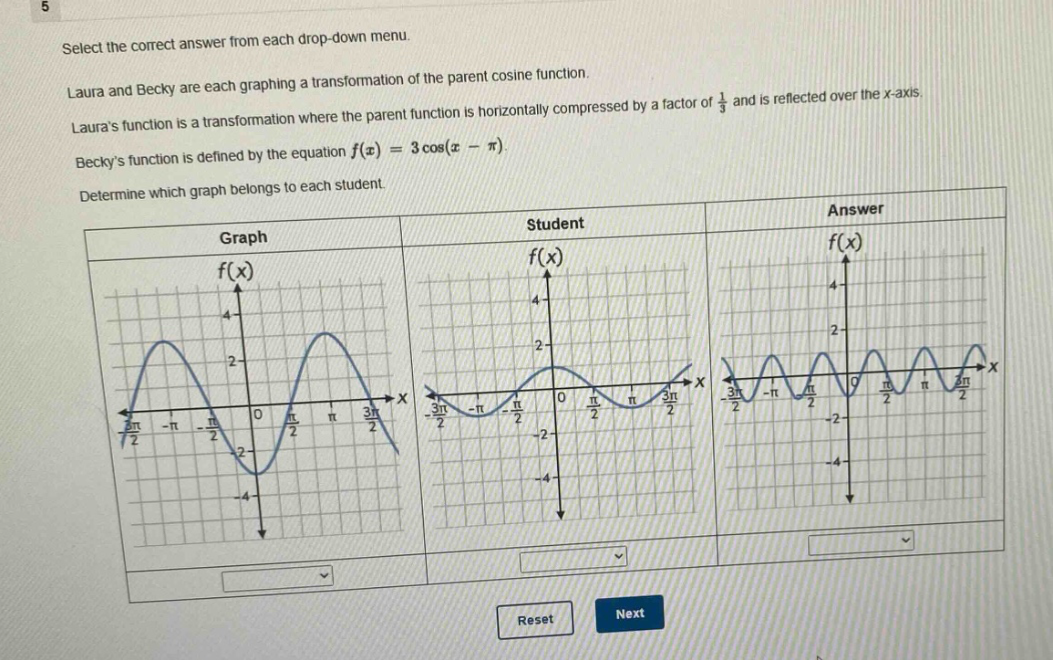
5 select the correct answer from each drop - down menu. laura and becky are each graphing a transformation of the parent cosine function. lauras function is a transformation where the parent function is horizontally compressed by a factor of 1/3 and is reflected over the x - axis. beckys function is defined by the equation f(x)=3cos(x - π). determine which graph belongs to each student. graph f(x) student f(x) answer f(x)
Answer
Explanation:
Step1: Analyze Laura's function
The parent - cosine function (y = \cos(x)) is horizontally compressed by a factor of (\frac{1}{3}), the transformation is (y=\cos(3x)), and then reflected over the (x) - axis, so the function is (y =-\cos(3x)). The period of (y = \cos(x)) is (2\pi), and for (y=\cos(3x)) the period is (\frac{2\pi}{3}), and the negative sign flips the graph upside - down.
Step2: Analyze Becky's function
For the function (f(x)=3\cos(x - \pi)), using the phase - shift formula (y = A\cos(Bx - C)) (here (A = 3), (B = 1), (C=\pi)). The phase - shift is (\frac{C}{B}=\pi) to the right, and the amplitude is (|A| = 3). The period of (y = 3\cos(x-\pi)) is (2\pi) since (B = 1).
Step3: Match the graphs
The graph with a period of (\frac{2\pi}{3}) and flipped over the (x) - axis belongs to Laura. The graph with a period of (2\pi) and an amplitude of 3 and a phase - shift of (\pi) belongs to Becky.
Answer:
Let's assume the graphs are labeled as Graph 1, Graph 2, Graph 3 from left - to - right. If the graph with a short period (period (\frac{2\pi}{3})) and flipped over the (x) - axis is Graph 3, then Laura's graph is Graph 3. If the graph with a period of (2\pi), amplitude 3 and phase - shift of (\pi) is Graph 1, then Becky's graph is Graph 1. (The actual identification depends on the specific characteristics of the graphs in terms of period, amplitude, and phase - shift visually, but the above is the general way of matching based on the function analysis).