select the correct answer from each drop - down menu.\nthe parent cosine function is transformed to create…
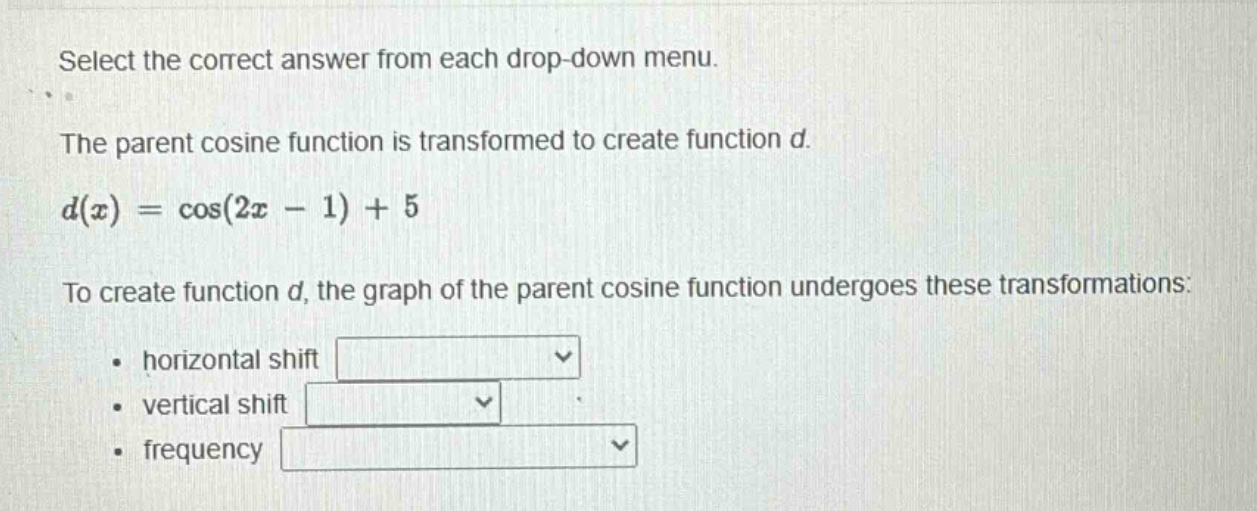
select the correct answer from each drop - down menu.\nthe parent cosine function is transformed to create function d.\nd(x)=cos(2x - 1)+5\nto create function d, the graph of the parent cosine function undergoes these transformations:\n• horizontal shift\n• vertical shift\n• frequency
Answer
Answer:
- horizontal shift: $\frac{1}{2}$ units to the right
- vertical shift: $5$ units up
- frequency: doubled
Explanation:
Step1: Analyze horizontal shift
For a function (y = \cos(Bx - C)+D), the horizontal shift is given by (\frac{C}{B}). Here (B = 2) and (C = 1), so (\frac{C}{B}=\frac{1}{2}). Since (C>0), it is a shift to the right.
Step2: Analyze vertical shift
For a function (y=\cos(Bx - C)+D), the vertical shift is (D). Here (D = 5), so it is a shift of (5) units up.
Step3: Analyze frequency
The general form of a cosine function is (y = A\cos(Bx - C)+D). The frequency of the parent function (y=\cos(x)) is (f_1=\frac{1}{2\pi}) (since period (T_1 = 2\pi)). For (y=\cos(2x - 1)+5), the period (T_2=\frac{2\pi}{B}=\frac{2\pi}{2}=\pi). The frequency (f_2=\frac{1}{\pi}). Since (f_2 = 2f_1), the frequency is doubled.