select the correct answer from each drop - down menu. which transformation causes the described change in…
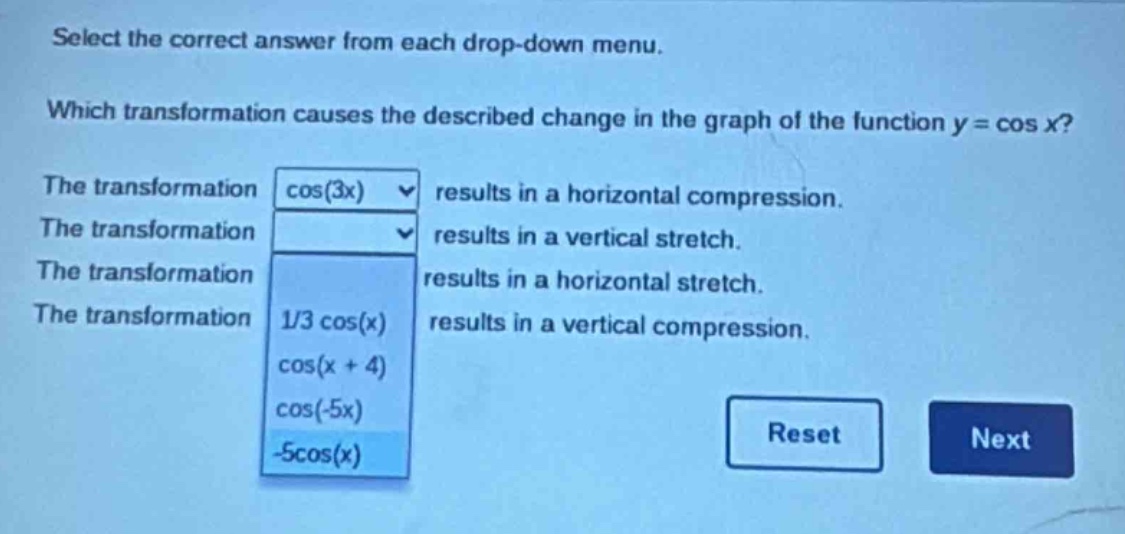
select the correct answer from each drop - down menu. which transformation causes the described change in the graph of the function y = cos x? the transformation cos(3x) results in a horizontal compression. the transformation results in a vertical stretch. the transformation results in a horizontal stretch. the transformation 1/3 cos(x) results in a vertical compression. cos(x + 4) cos(-5x) -5cos(x) reset next
Answer
Explanation:
Step1: Recall vertical - stretch rule
For a function $y = f(x)$, $y = a\cdot f(x)$ where $|a|> 1$ causes a vertical stretch.
Step2: Analyze given options
For $y=\cos x$, the function $y = - 5\cos(x)$ has $a=-5$ and $| - 5|=5>1$, so it results in a vertical stretch.
Step3: Recall horizontal - stretch rule
For a function $y = f(x)$, $y = f(bx)$ where $0 < |b|<1$ causes a horizontal stretch. For $y=\cos x$, if we consider $y=\cos\left(\frac{1}{3}x\right)$ (not in the options but for understanding the rule), for the given options $y=\cos(x + 4)$ is a horizontal shift, $y=\cos(-5x)=\cos(5x)$ is a horizontal compression ($|b| = 5>1$), and the correct form for horizontal stretch among the options is not present in a pure form but the concept is based on the coefficient of $x$ inside the cosine function.
Answer:
The transformation $-5\cos(x)$ results in a vertical stretch.