select the correct answer from each drop - down menu. which transformation causes the described change in…
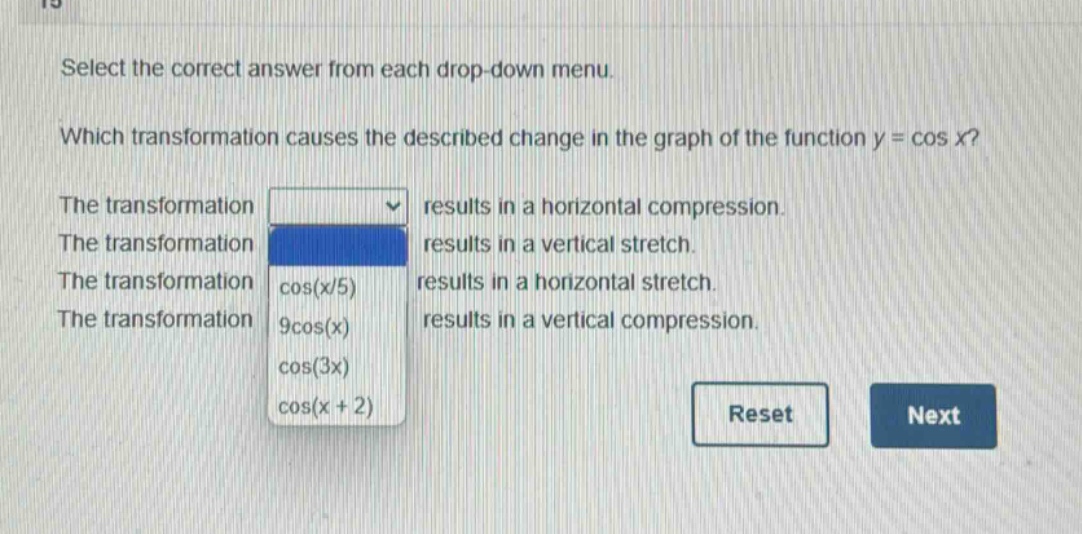
select the correct answer from each drop - down menu. which transformation causes the described change in the graph of the function y = cos x? the transformation results in a horizontal compression. the transformation results in a vertical stretch. the transformation cos(x/5) results in a horizontal stretch. the transformation 9cos(x) results in a vertical compression. the transformation cos(3x) cos(x + 2)
Answer
Explanation:
Step1: Recall horizontal - compression rule
For the function $y = f(x)$, the transformation $y=f(bx)$ with $b> 1$ causes a horizontal compression. For $y = \cos x$, when $y=\cos(3x)$ ($b = 3>1$), it results in a horizontal compression.
Step2: Recall vertical - stretch rule
For the function $y = f(x)$, the transformation $y = af(x)$ with $a>1$ causes a vertical stretch. For $y=\cos x$, when $y = 9\cos(x)$ ($a = 9>1$), it results in a vertical stretch.
Step3: Recall horizontal - stretch rule
For the function $y = f(x)$, the transformation $y=f(bx)$ with $0 < b<1$ causes a horizontal stretch. For $y=\cos x$, when $y=\cos(\frac{x}{5})$ ($b=\frac{1}{5},0 < b<1$), it results in a horizontal stretch.
Step4: Recall vertical - compression rule
There is no correct option for vertical compression in the given list. A vertical compression for $y = f(x)$ is of the form $y=af(x)$ where $0 < a<1$.
Answer:
The transformation $\cos(3x)$ results in a horizontal compression. The transformation $9\cos(x)$ results in a vertical stretch. The transformation $\cos(\frac{x}{5})$ results in a horizontal stretch. There is no correct option for vertical compression.