select the correct answer. which function has an asymptote at x = 5 and an x - intercept of (6,0)?\na…
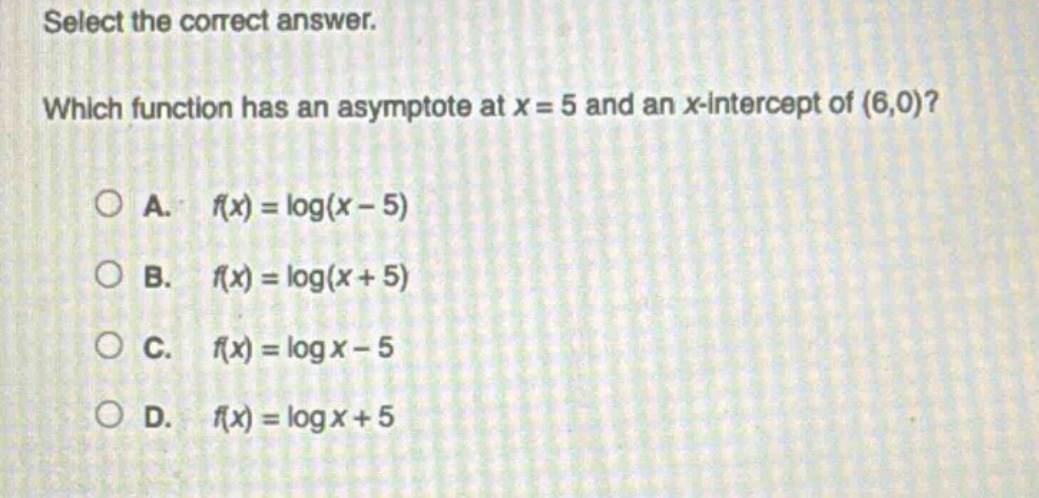
select the correct answer. which function has an asymptote at x = 5 and an x - intercept of (6,0)?\na. (f(x)=log(x - 5))\nb. (f(x)=log(x + 5))\nc. (f(x)=log x-5)\nd. (f(x)=log x + 5)
Answer
Explanation:
Step1: Recall vertical - asymptote property of logarithmic functions
For the function $y = \log(u)$, the vertical asymptote occurs when $u = 0$.
Step2: Check the vertical asymptote of option A
For $f(x)=\log(x - 5)$, set $x-5=0$, then $x = 5$ is the vertical asymptote.
Step3: Check the x - intercept of option A
To find the x - intercept, set $y = f(x)=0$. For $f(x)=\log(x - 5)=0$, since $\log1=0$, we have $x-5 = 1$, which gives $x=6$. So the x - intercept is $(6,0)$.
Step4: Check option B
For $f(x)=\log(x + 5)$, setting $x + 5=0$ gives $x=-5$ as the vertical asymptote, so it's not correct.
Step5: Check option C
For $f(x)=\log x-5$, the vertical asymptote is $x = 0$ (since for $y=\log x$, the asymptote is $x = 0$), so it's not correct.
Step6: Check option D
For $f(x)=\log x + 5$, the vertical asymptote is $x = 0$, so it's not correct.
Answer:
A. $f(x)=\log(x - 5)$