select the correct answer. function r is a continuous rational function with a horizontal asymptote at y =…
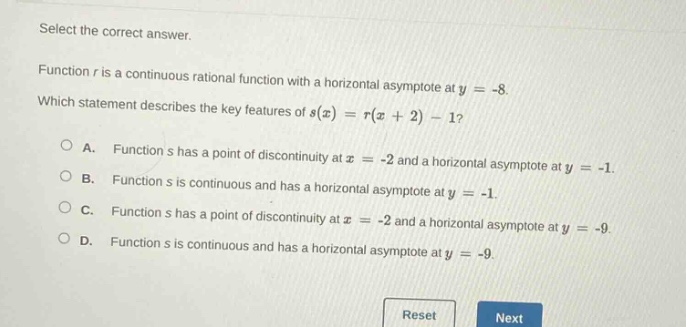
select the correct answer. function r is a continuous rational function with a horizontal asymptote at y = -8. which statement describes the key features of s(x)=r(x + 2)-1? a. function s has a point of discontinuity at x = -2 and a horizontal asymptote at y = -1. b. function s is continuous and has a horizontal asymptote at y = -1. c. function s has a point of discontinuity at x = -2 and a horizontal asymptote at y = -9. d. function s is continuous and has a horizontal asymptote at y = -9. reset next
Answer
Explanation:
Step1: Recall transformation rules
For a function (y = r(x)) and its transformation (s(x)=r(x + 2)-1), the graph of (r(x)) is shifted 2 units to the left and 1 unit down.
Step2: Analyze continuity
Since (r(x)) is a continuous rational - function, shifting it horizontally and vertically does not introduce any points of discontinuity. So (s(x)) is also continuous.
Step3: Analyze horizontal asymptote
The horizontal asymptote of (r(x)) is (y = - 8). When we transform (r(x)) to (s(x)=r(x + 2)-1), the horizontal asymptote of (s(x)) is obtained by shifting the horizontal asymptote of (r(x)) 1 unit down. So the horizontal asymptote of (s(x)) is (y=-8 - 1=-9).
Answer:
D. Function s is continuous and has a horizontal asymptote at (y=-9)