select the correct answer. which function is increasing and has a vertical asymptote at x = 5? a. f(x)= -ln…
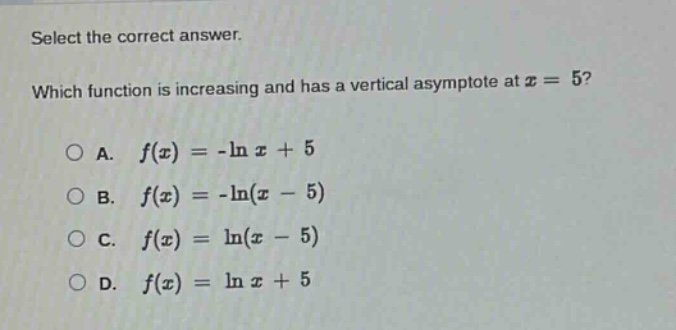
select the correct answer. which function is increasing and has a vertical asymptote at x = 5? a. f(x)= -ln x + 5 b. f(x)= -ln(x - 5) c. f(x)= ln(x - 5) d. f(x)= ln x + 5
Answer
Explanation:
Step1: Recall properties of logarithmic functions
The natural - logarithm function (y = \ln(u)) has a vertical asymptote at (u = 0) and is increasing for (u>0).
Step2: Analyze the vertical - asymptote condition
For a function of the form (y=\ln(x - a)), the vertical asymptote is given by (x - a=0), or (x = a). We want a vertical asymptote at (x = 5), so the function should be of the form (y=\ln(x - 5)) or (y=-\ln(x - 5)) since for (y = \ln(x - 5)), when (x-5=0) (i.e., (x = 5)), it has a vertical asymptote, and for (y=-\ln(x - 5)), when (x - 5=0) (i.e., (x = 5)), it also has a vertical asymptote.
Step3: Analyze the increasing - function condition
The derivative of (y=\ln(u)) with respect to (x) is (y^\prime=\frac{u^\prime}{u}) (by the chain - rule). For (y = \ln(x - 5)), let (u=x - 5), then (u^\prime=1), and (y^\prime=\frac{1}{x - 5}). Since (y^\prime=\frac{1}{x - 5}>0) for (x>5), the function (y = \ln(x - 5)) is increasing for (x>5). The derivative of (y=-\ln(x - 5)) is (y^\prime=-\frac{1}{x - 5}<0) for (x>5), so it is decreasing for (x>5). The functions (y =-\ln x+5) and (y=\ln x + 5) have a vertical asymptote at (x = 0).
Answer:
C. (f(x)=\ln(x - 5))