select the correct answer. which graph represents the given function? $f(x)=-\frac{3}{2}(2)^{x}+3$
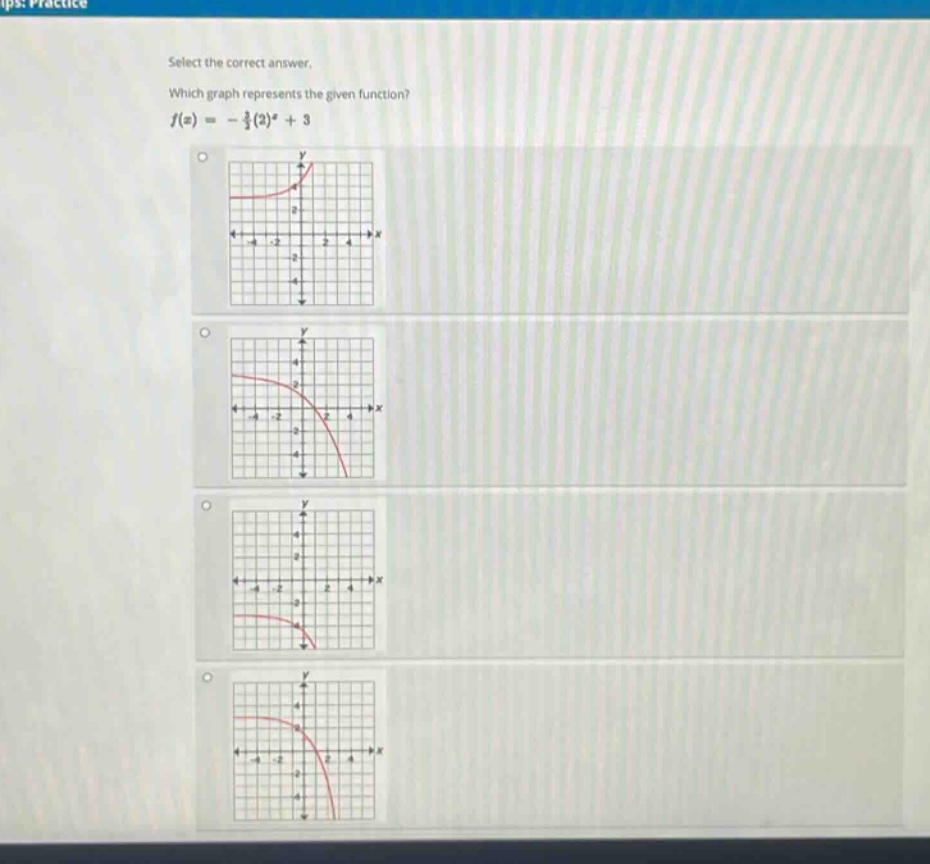
select the correct answer. which graph represents the given function? $f(x)=-\frac{3}{2}(2)^{x}+3$
Answer
Explanation:
Step1: Analyze the general form of exponential - function
The given function is (f(x)=-\frac{3}{2}(2)^{x}+3), which is an exponential function of the form (y = ab^{x}+c), where (a =-\frac{3}{2}), (b = 2), and (c = 3). Since (b=2>1), the basic exponential function (y = 2^{x}) is an increasing function. But because (a=-\frac{3}{2}<0), the function (y =-\frac{3}{2}(2)^{x}) is a reflection of (y=\frac{3}{2}(2)^{x}) about the (x) - axis, so (y =-\frac{3}{2}(2)^{x}) is a decreasing function. And then (y =-\frac{3}{2}(2)^{x}+3) is a vertical shift of (y =-\frac{3}{2}(2)^{x}) up by 3 units.
Step2: Find the (y) - intercept
To find the (y) - intercept, set (x = 0). Then (f(0)=-\frac{3}{2}(2)^{0}+3=-\frac{3}{2}+3=\frac{-3 + 6}{2}=\frac{3}{2}).
Step3: Analyze the horizontal asymptote
For an exponential function of the form (y = ab^{x}+c), the horizontal asymptote is (y = c). Here, (c = 3), so the horizontal asymptote is (y = 3). The function (y=-\frac{3}{2}(2)^{x}+3) approaches (y = 3) as (x\to-\infty) and approaches (-\infty) as (x\to+\infty).
Answer:
The graph that is a decreasing curve with a (y) - intercept at ((0,\frac{3}{2})) and a horizontal asymptote at (y = 3) is the correct one. (Since the graphs are not labeled with options, you need to identify the graph with these characteristics among the given choices).