select the correct answer.\nrational function $h$ is continuous, with a horizontal asymptote at $y = 1$…
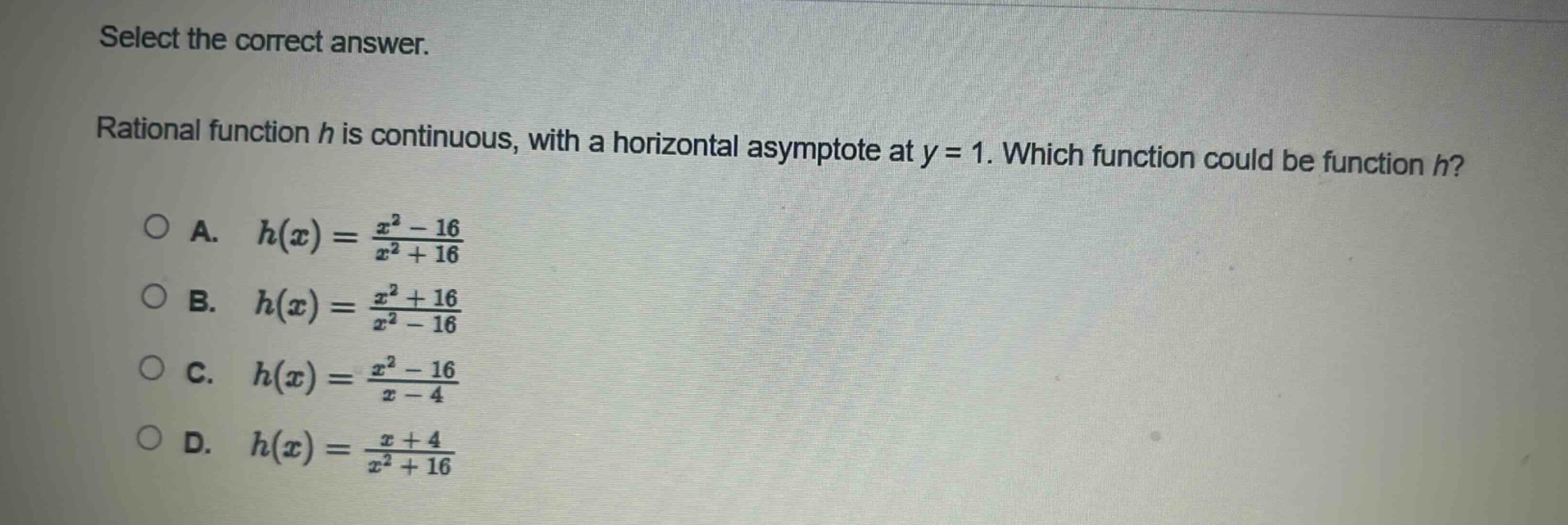
select the correct answer.\nrational function $h$ is continuous, with a horizontal asymptote at $y = 1$. which function could be function $h$?\na. $h(x)=\frac{x^{2}-16}{x^{2}+16}$\nb. $h(x)=\frac{x^{2}+16}{x^{2}-16}$\nc. $h(x)=\frac{x^{2}-16}{x - 4}$\nd. $h(x)=\frac{x + 4}{x^{2}+16}$
Answer
Explanation:
Step1: Recall horizontal - asymptote rules
For a rational function $h(x)=\frac{f(x)}{g(x)}$ where $f(x)=a_nx^n+\cdots+a_0$ and $g(x)=b_mx^m+\cdots + b_0$, if $n = m$, the horizontal asymptote is $y=\frac{a_n}{b_m}$.
Step2: Analyze option A
For $h(x)=\frac{x^{2}-16}{x^{2}+16}$, the degree of the numerator $n = 2$ and the degree of the denominator $m = 2$. Here, $a_n = 1$ and $b_m=1$. So, $\lim_{x\rightarrow\pm\infty}h(x)=\lim_{x\rightarrow\pm\infty}\frac{x^{2}-16}{x^{2}+16}=\lim_{x\rightarrow\pm\infty}\frac{1-\frac{16}{x^{2}}}{1 + \frac{16}{x^{2}}}=1$. Also, the denominator $x^{2}+16\neq0$ for all real $x$, so the function is continuous.
Step3: Analyze option B
For $h(x)=\frac{x^{2}+16}{x^{2}-16}$, the denominator $x^{2}-16=(x + 4)(x - 4)=0$ when $x=\pm4$, so the function is not continuous.
Step4: Analyze option C
For $h(x)=\frac{x^{2}-16}{x - 4}=\frac{(x + 4)(x - 4)}{x - 4}=x + 4,x\neq4$. It has a removable - discontinuity at $x = 4$ and is not a rational function in the proper sense for the whole real line. Also, it is a linear function for $x\neq4$ and has no horizontal asymptote.
Step5: Analyze option D
For $h(x)=\frac{x + 4}{x^{2}+16}$, the degree of the numerator $n = 1$ and the degree of the denominator $m = 2$. Since $n<m$, $\lim_{x\rightarrow\pm\infty}h(x)=0$, so the horizontal asymptote is $y = 0$.
Answer:
A. $h(x)=\frac{x^{2}-16}{x^{2}+16}$