select the correct answer.\nwhich statement describes the end - behavior of this function?\nf(x)=log(x…
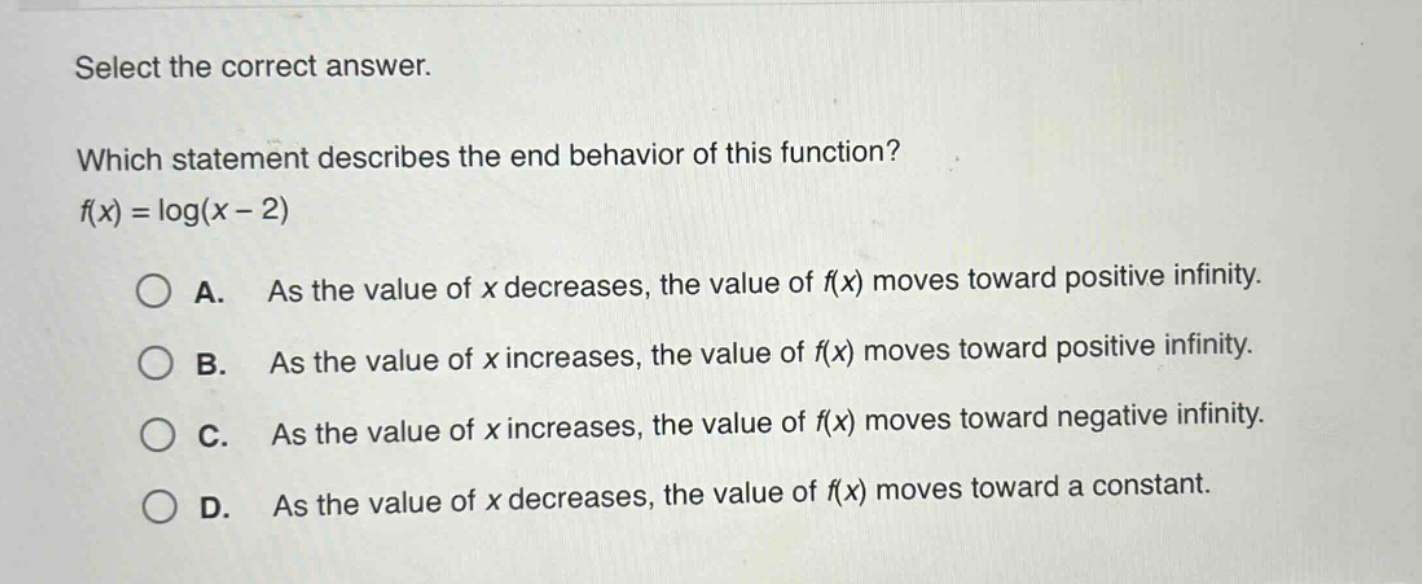
select the correct answer.\nwhich statement describes the end - behavior of this function?\nf(x)=log(x - 2)\na. as the value of x decreases, the value of f(x) moves toward positive infinity.\nb. as the value of x increases, the value of f(x) moves toward positive infinity.\nc. as the value of x increases, the value of f(x) moves toward negative infinity.\nd. as the value of x decreases, the value of f(x) moves toward a constant.
Answer
Explanation:
Step1: Recall log - function end - behavior
The general form of a logarithmic function is $y = \log_a(x)$ (here $a = 10$ as it is a common logarithm), and its domain is $x>0$. For the function $f(x)=\log(x - 2)$, the domain is $x-2>0$ or $x > 2$.
Step2: Analyze as $x$ increases
As $x$ increases without bound ($x\rightarrow+\infty$), the argument of the logarithm $x - 2$ also increases without bound. Since the logarithmic function $y=\log(u)$ is an increasing function (if $u_1<u_2$, then $\log(u_1)<\log(u_2)$), when $u=x - 2\rightarrow+\infty$, $f(x)=\log(x - 2)\rightarrow+\infty$.
Step3: Analyze as $x$ decreases
As $x$ approaches 2 from the right ($x\rightarrow2^{+}$), the argument $x - 2\rightarrow0^{+}$. And $\log(x - 2)\rightarrow-\infty$. As $x$ decreases further from values greater than 2, $\log(x - 2)$ still approaches $-\infty$.
Answer:
B. As the value of $x$ increases, the value of $f(x)$ moves toward positive infinity.