select the correct answer. which statement describes the end - behavior of this function? (f(x)=log(x - 2))…
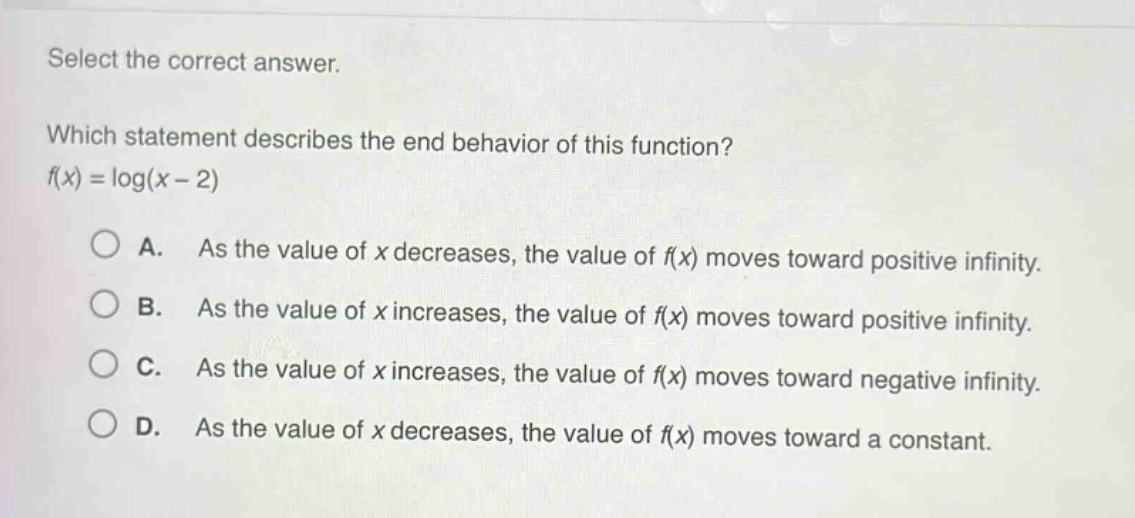
select the correct answer. which statement describes the end - behavior of this function? (f(x)=log(x - 2)) a. as the value of (x) decreases, the value of (f(x)) moves toward positive infinity. b. as the value of (x) increases, the value of (f(x)) moves toward positive infinity. c. as the value of (x) increases, the value of (f(x)) moves toward negative infinity. d. as the value of (x) decreases, the value of (f(x)) moves toward a constant.
Answer
Explanation:
Step1: Recall log - function properties
The domain of (y = \log(x - 2)) is (x>2). The general form of a logarithmic function (y=\log_a u) ((a > 1)) has the following end - behavior.
Step2: Analyze as (x) increases
As (x\to+\infty), (u=x - 2\to+\infty). For the function (y = \log(x - 2)) (assuming base (a>1)), when (u=x - 2) gets larger and larger, (\log(x - 2)\to+\infty).
Step3: Analyze as (x) decreases
As (x) approaches 2 from the right ((x\to2^{+})), (u=x - 2\to0^{+}), and (\log(x - 2)\to-\infty).
Answer:
B. As the value of (x) increases, the value of (f(x)) moves toward positive infinity.