select the correct answer. which statement about the end - behavior of the logarithmic function (f(x)=log(x…
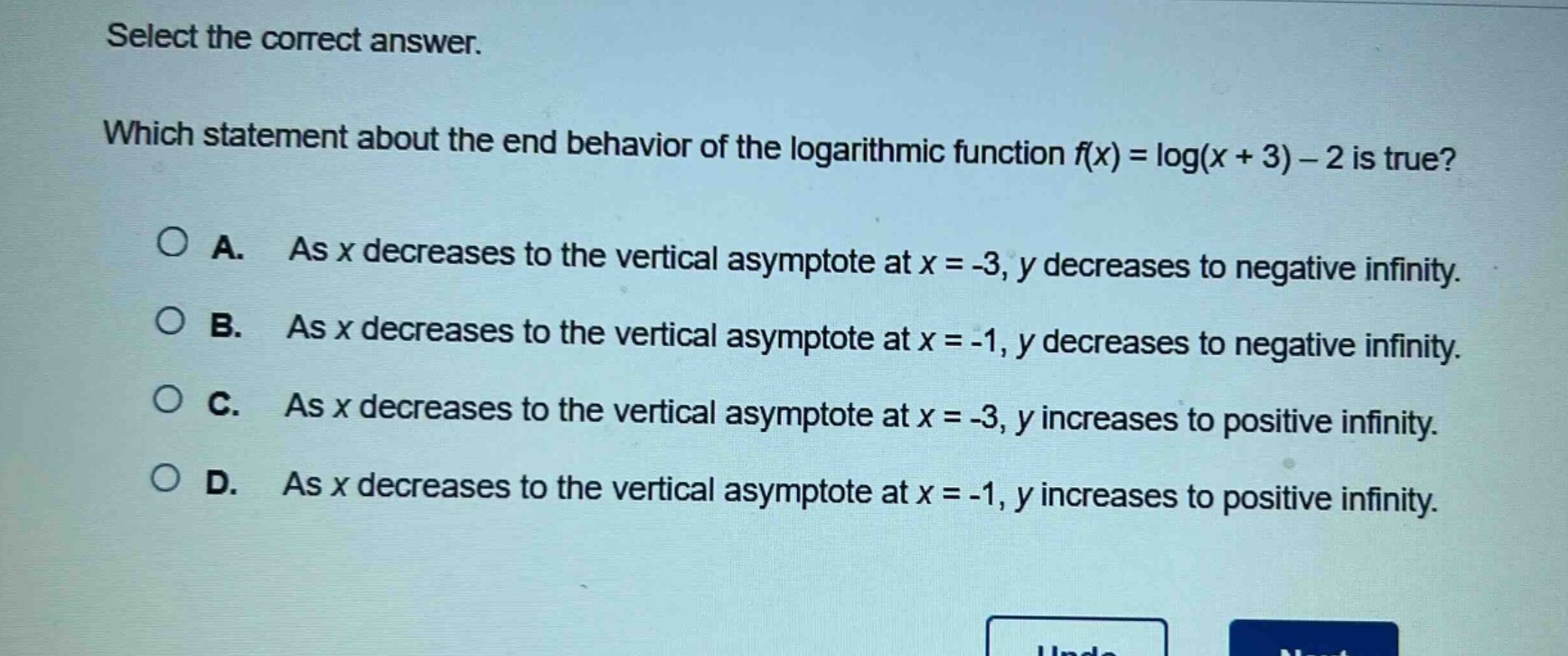
select the correct answer. which statement about the end - behavior of the logarithmic function (f(x)=log(x + 3)-2) is true? a. as (x) decreases to the vertical asymptote at (x=-3), (y) decreases to negative infinity. b. as (x) decreases to the vertical asymptote at (x=-1), (y) decreases to negative infinity. c. as (x) decreases to the vertical asymptote at (x=-3), (y) increases to positive infinity. d. as (x) decreases to the vertical asymptote at (x=-1), (y) increases to positive infinity.
Answer
Explanation:
Step1: Find the vertical asymptote
For the logarithmic function $y = \log(x + 3)-2$, the argument of the logarithm must be positive. Set $x+3>0$, solving for $x$ gives $x>- 3$. The vertical - asymptote occurs when the argument of the logarithm is zero, so $x=-3$ is the vertical asymptote.
Step2: Analyze the end - behavior
The parent function of $y = \log(x + 3)-2$ is $y=\log(x)$. The general form of a logarithmic function $y = \log_a(x)$ (assuming base $a>1$) has the property that as $x$ approaches the vertical asymptote from the right, $y$ decreases to negative infinity. For the function $y=\log(x + 3)-2$, as $x$ decreases to the vertical asymptote at $x=-3$, the value of $y$ decreases to negative infinity.
Answer:
A. As $x$ decreases to the vertical asymptote at $x = -3$, $y$ decreases to negative infinity.