select the correct answer.\nwhich statement is true about the graph of function f?\nf(x) = log₂x\n\na. the…
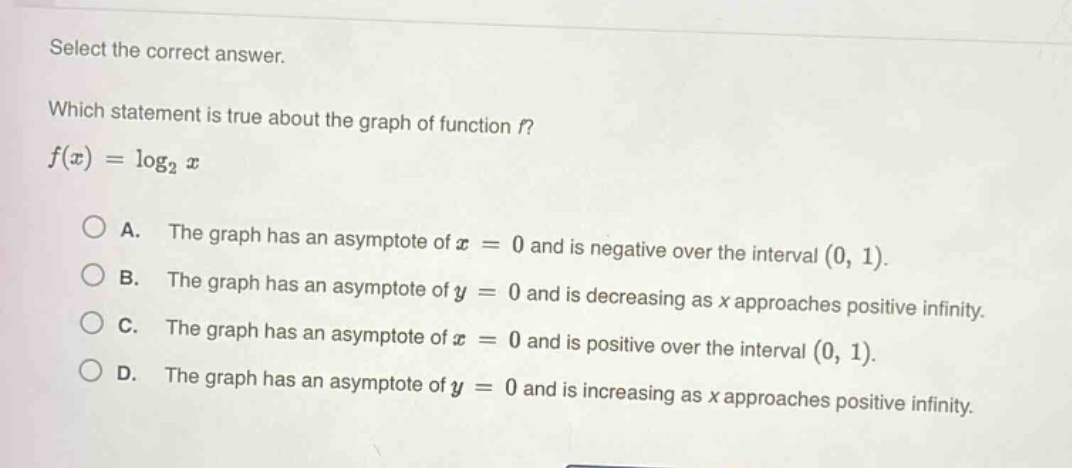
select the correct answer.\nwhich statement is true about the graph of function f?\nf(x) = log₂x\n\na. the graph has an asymptote of x = 0 and is negative over the interval (0, 1).\nb. the graph has an asymptote of y = 0 and is decreasing as x approaches positive infinity.\nc. the graph has an asymptote of x = 0 and is positive over the interval (0, 1).\nd. the graph has an asymptote of y = 0 and is increasing as x approaches positive infinity.
Answer
Explanation:
Step1: Recall properties of logarithmic functions
The general form of a logarithmic function is $y = \log_{a}x$, where $a>0,a\neq1$ and $x > 0$. For the function $y=\log_{2}x$, the domain is $(0,+\infty)$. The vertical - asymptote occurs when the argument of the logarithm approaches 0. So, the vertical asymptote is $x = 0$.
Step2: Analyze the sign of the function on the interval $(0,1)$
We know that if $y=\log_{2}x$, when $x\in(0,1)$, we can use the property $\log_{a}x=\frac{\ln x}{\ln a}$. For $x\in(0,1)$, $\ln x<0$ and $\ln 2>0$, so $\log_{2}x<0$. Also, the function $y = \log_{2}x$ is an increasing function since the base $a = 2>1$, and as $x\rightarrow+\infty$, $y=\log_{2}x\rightarrow+\infty$.
Answer:
A. The graph has an asymptote of $x = 0$ and is negative over the interval $(0,1)$.