select the correct answer.\nthis table represents function f.\n| x | -3 | -2 | -1 | 0 | 1 | 2 | 3 |\n| f(x)…
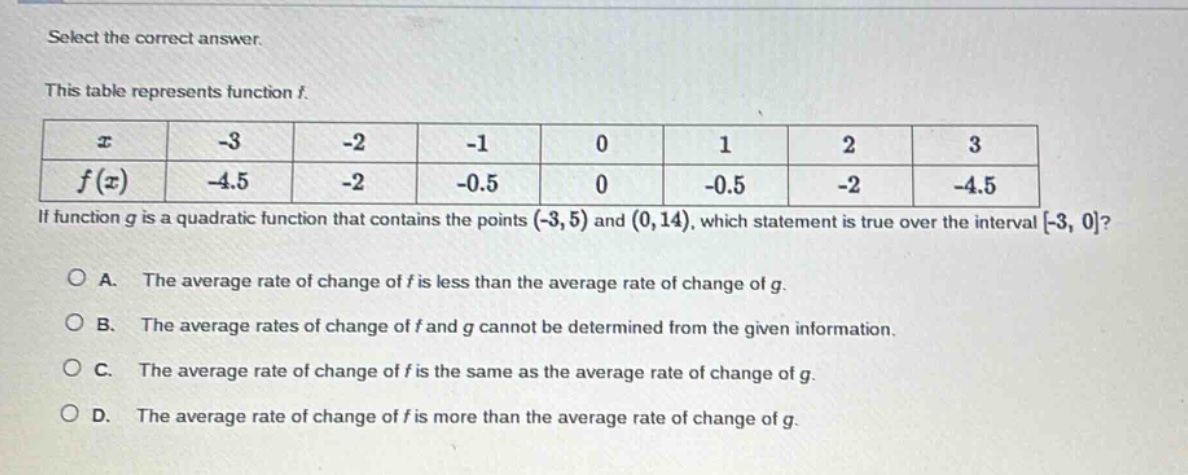
select the correct answer.\nthis table represents function f.\n| x | -3 | -2 | -1 | 0 | 1 | 2 | 3 |\n| f(x) | -4.5 | -2 | -0.5 | 0 | -0.5 | -2 | -4.5 |\nif function g is a quadratic function that contains the points (-3,5) and (0,14), which statement is true over the interval -3, 0?\na. the average rate of change of f is less than the average rate of change of g.\nb. the average rates of change of f and g cannot be determined from the given information.\nc. the average rate of change of f is the same as the average rate of change of g.\nd. the average rate of change of f is more than the average rate of change of g.
Answer
Explanation:
Step1: Calculate average rate of change of (f)
The formula for average rate of change of a function (y = f(x)) over the interval ([a,b]) is (\frac{f(b)-f(a)}{b - a}). For function (f) over the interval ([-3,0]), (a=-3), (b = 0), (f(-3)=-4.5) and (f(0)=0). So the average rate of change of (f) is (\frac{f(0)-f(-3)}{0-(-3)}=\frac{0 - (-4.5)}{3}=\frac{4.5}{3}=1.5).
Step2: Calculate average rate of change of (g)
For function (g) which is quadratic and contains points ((-3,5)) and ((0,14)). Using the average - rate - of - change formula (\frac{g(b)-g(a)}{b - a}) with (a=-3), (b = 0), (g(-3)=5) and (g(0)=14). The average rate of change of (g) is (\frac{g(0)-g(-3)}{0-(-3)}=\frac{14 - 5}{3}=\frac{9}{3}=3).
Step3: Compare the average rates of change
Since (1.5<3), the average rate of change of (f) is less than the average rate of change of (g) over the interval ([-3,0]).
Answer:
A. The average rate of change of (f) is less than the average rate of change of (g).