select all the correct answers. consider function f and function g. f(x) = ln x g(x) = -5 ln x how does the…
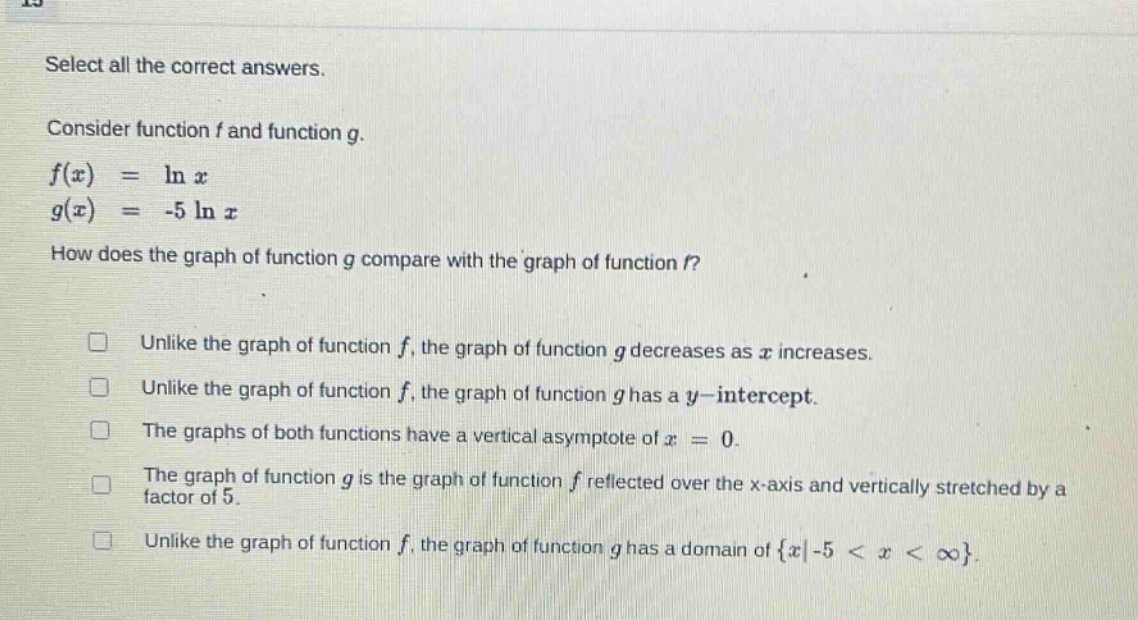
select all the correct answers. consider function f and function g. f(x) = ln x g(x) = -5 ln x how does the graph of function g compare with the graph of function f? unlike the graph of function f, the graph of function g decreases as x increases. unlike the graph of function f, the graph of function g has a y - intercept. the graphs of both functions have a vertical asymptote of x = 0. the graph of function g is the graph of function f reflected over the x - axis and vertically stretched by a factor of 5. unlike the graph of function f, the graph of function g has a domain of {x|-5 < x < ∞}.
Answer
Explanation:
Step1: Analyze the derivative of the functions
The derivative of $f(x)=\ln x$ is $f^\prime(x)=\frac{1}{x}$, and for $g(x)= - 5\ln x$, its derivative is $g^\prime(x)=-\frac{5}{x}$. For $x>0$, when $x$ increases, $f^\prime(x)>0$ so $f(x)$ increases, and $g^\prime(x)<0$ so $g(x)$ decreases.
Step2: Check the y - intercept
The domain of $y = \ln x$ and $y=-5\ln x$ is $x>0$. Since $x = 0$ is not in the domain, neither function has a y - intercept.
Step3: Determine the vertical asymptote
As $x\rightarrow0^{+}$, $\ln x\rightarrow-\infty$ and $-5\ln x\rightarrow\infty$. So the vertical asymptote of both $y = f(x)$ and $y = g(x)$ is $x = 0$.
Step4: Analyze the transformation
The function $g(x)=-5\ln x=- 5\times f(x)$. The negative sign reflects the graph of $f(x)$ over the x - axis, and the coefficient 5 vertically stretches the graph by a factor of 5.
Step5: Check the domain
The domain of $f(x)=\ln x$ and $g(x)=-5\ln x$ is $x>0$, not ${x|-5 < x<\infty}$.
Answer:
- A. Unlike the graph of function $f$, the graph of function $g$ decreases as $x$ increases.
- C. The graphs of both functions have a vertical asymptote of $x = 0$.
- D. The graph of function $g$ is the graph of function $f$ reflected over the x - axis and vertically stretched by a factor of 5.