select all the correct answers. which statements are true about function $g$? $g(x)=\begin{cases}(\frac{1}{2}…
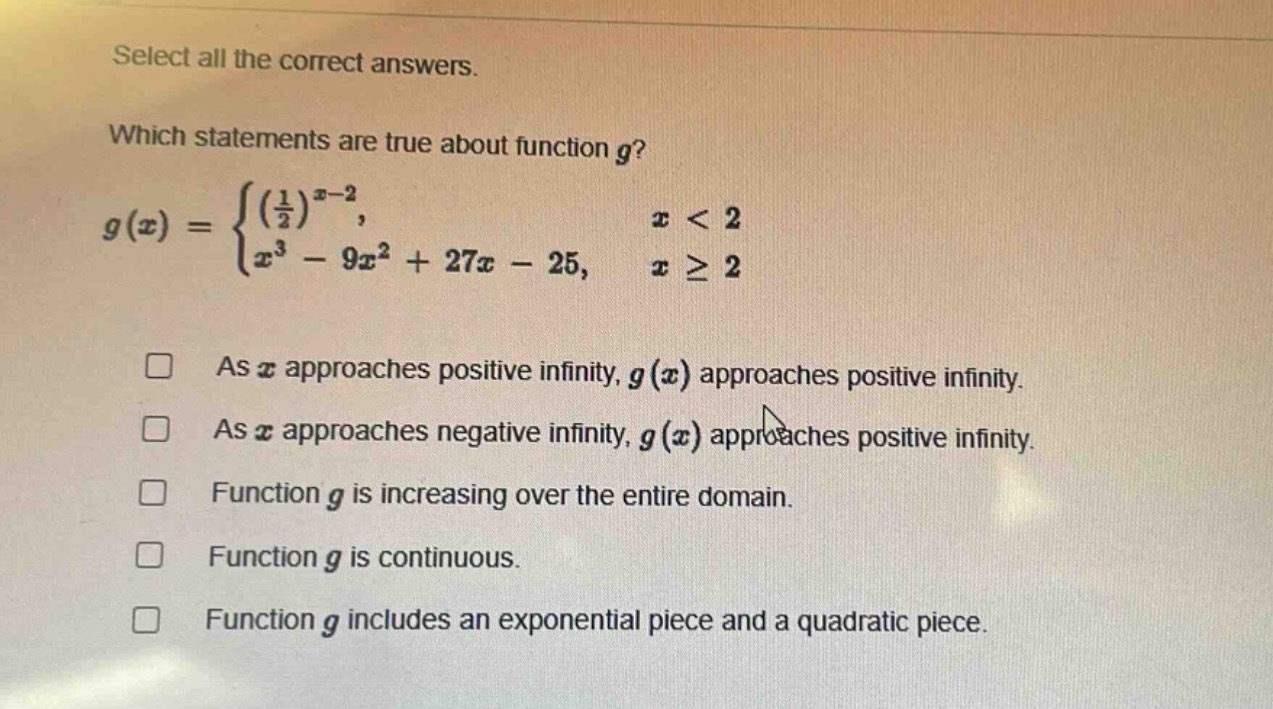
select all the correct answers. which statements are true about function $g$? $g(x)=\begin{cases}(\frac{1}{2})^{x - 2},&x < 2\\x^{3}-9x^{2}+27x - 25,&xgeq2end{cases}$ as $x$ approaches positive infinity, $g(x)$ approaches positive infinity. as $x$ approaches negative infinity, $g(x)$ approaches positive infinity. function $g$ is increasing over the entire domain. function $g$ is continuous. function $g$ includes an exponential piece and a quadratic piece.
Answer
Explanation:
Step1: Analyze as $x\to+\infty$
For $x\geq2$, $g(x)=x^{3}-9x^{2}+27x - 25$. The leading - term of the polynomial is $x^{3}$. As $x\to+\infty$, $x^{3}\to+\infty$, so $g(x)\to+\infty$. The first statement is true.
Step2: Analyze as $x\to-\infty$
For $x < 2$, $g(x)=(\frac{1}{2})^{x - 2}$. Since the base of the exponential function $y = a^{x}$ with $0 < a<1$ is $\frac{1}{2}$ and the exponent $x-2\to-\infty$ as $x\to-\infty$, then $(\frac{1}{2})^{x - 2}\to+\infty$. The second statement is true.
Step3: Analyze the monotonicity
For $x < 2$, $g(x)=(\frac{1}{2})^{x - 2}$ is a decreasing exponential function. For $x\geq2$, $g(x)=x^{3}-9x^{2}+27x - 25$, and $g^\prime(x)=3x^{2}-18x + 27=3(x^{2}-6x + 9)=3(x - 3)^{2}\geq0$. It is non - decreasing for $x\geq2$. So $g(x)$ is not increasing over the entire domain. The third statement is false.
Step4: Analyze the continuity
Find the left - hand limit as $x\to2^{-}$: $\lim_{x\to2^{-}}g(x)=\lim_{x\to2^{-}}(\frac{1}{2})^{x - 2}=(\frac{1}{2})^{2 - 2}=1$. Find the right - hand limit as $x\to2^{+}$: $\lim_{x\to2^{+}}g(x)=2^{3}-9\times2^{2}+27\times2 - 25=8-36 + 54 - 25=1$. Also, $g(2)=2^{3}-9\times2^{2}+27\times2 - 25 = 1$. So $g(x)$ is continuous. The fourth statement is true.
Step5: Analyze the components of the function
$g(x)$ has an exponential piece $(\frac{1}{2})^{x - 2}$ for $x < 2$ and a cubic piece $x^{3}-9x^{2}+27x - 25$ for $x\geq2$, not a quadratic piece. The fifth statement is false.
Answer:
As $x$ approaches positive infinity, $g(x)$ approaches positive infinity; As $x$ approaches negative infinity, $g(x)$ approaches positive infinity; Function $g$ is continuous.