select the correct ordered pairs in the table. consider the function below, which has a relative minimum…
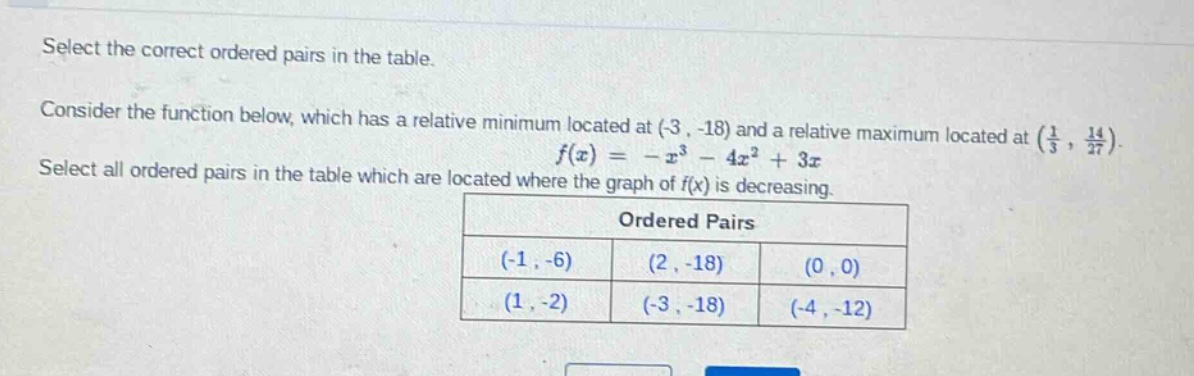
select the correct ordered pairs in the table. consider the function below, which has a relative minimum located at (-3, -18) and a relative maximum located at (1/3, 14/27). f(x)= -x³ - 4x² + 3x select all ordered pairs in the table which are located where the graph of f(x) is decreasing. ordered pairs (-1, -6) (2, -18) (0, 0) (1, -2) (-3, -18) (-4, -12)
Answer
Explanation:
Step1: Find the derivative of the function
First, find the derivative of $f(x)=-x^{3}-4x^{2}+3x$. Using the power - rule $(x^n)' = nx^{n - 1}$, we have $f'(x)=-3x^{2}-8x + 3$.
Step2: Find the critical points
Set $f'(x)=0$, so $-3x^{2}-8x + 3 = 0$. Multiply through by - 1 to get $3x^{2}+8x - 3=0$. Factor: $(3x - 1)(x + 3)=0$. The critical points are $x=-3$ and $x=\frac{1}{3}$.
Step3: Determine the intervals of decrease
We use test points in the intervals $(-\infty,-3)$, $(-3,\frac{1}{3})$, and $(\frac{1}{3},\infty)$. For the interval $(-\infty,-3)$, let $x=-4$. Then $f'(-4)=-3(-4)^{2}-8(-4)+3=-48 + 32+3=-13<0$. For the interval $(-3,\frac{1}{3})$, let $x = 0$. Then $f'(0)=-3(0)^{2}-8(0)+3 = 3>0$. For the interval $(\frac{1}{3},\infty)$, let $x = 1$. Then $f'(1)=-3(1)^{2}-8(1)+3=-3 - 8+3=-8<0$. The function is decreasing on the intervals $(-\infty,-3)$ and $(\frac{1}{3},\infty)$.
Step4: Check the ordered - pairs
For $(-1,-6)$: $-1\in(-3,\frac{1}{3})$, function is increasing. For $(2,-18)$: $2\in(\frac{1}{3},\infty)$, function is decreasing. For $(0,0)$: $0\in(-3,\frac{1}{3})$, function is increasing. For $(1,-2)$: $1\in(\frac{1}{3},\infty)$, function is decreasing. For $(-3,-18)$: at a critical - point, not strictly decreasing. For $(-4,-12)$: $-4\in(-\infty,-3)$, function is decreasing.
Answer:
$(2,-18),(1,-2),(-4,-12)$