select the correct statements in the passage.\nhilarys teacher asked her to write a description of the…
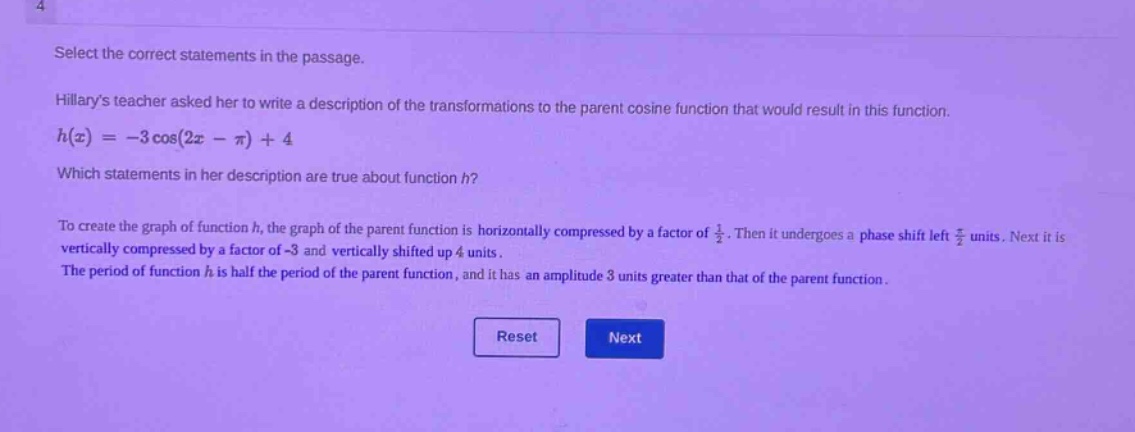
select the correct statements in the passage.\nhilarys teacher asked her to write a description of the transformations to the parent cosine function that would result in this function.\nh(x)=-3\\cos(2x - \\pi)+4\nwhich statements in her description are true about function h?\nto create the graph of function h, the graph of the parent function is horizontally compressed by a factor of \\frac{1}{2}. then it undergoes a phase shift left \\frac{\\pi}{2} units. next it is vertically compressed by a factor of -3 and vertically shifted up 4 units.\nthe period of function h is half the period of the parent function, and it has an amplitude 3 units greater than that of the parent function.\nreset next
Answer
Explanation:
Step1: Recall general form of cosine transformation
The general form of a cosine - function transformation is $y = A\cos(Bx - C)+D$, where $|A|$ is the amplitude, $\frac{2\pi}{|B|}$ is the period, $\frac{C}{B}$ is the phase - shift, and $D$ is the vertical shift. For the function $h(x)=-3\cos(2x - \pi)+4$, we have $A=-3$, $B = 2$, $C=\pi$, and $D = 4$.
Step2: Analyze horizontal compression
The period of the parent cosine function $y=\cos(x)$ is $T_0 = 2\pi$. The period of $h(x)$ is $T=\frac{2\pi}{|B|}=\frac{2\pi}{2}=\pi$. A horizontal compression by a factor of $\frac{1}{k}$ is given by replacing $x$ with $kx$. Here, since $B = 2$, the graph of the parent function is horizontally compressed by a factor of $\frac{1}{2}$.
Step3: Analyze phase - shift
The phase - shift is given by $\frac{C}{B}$. For $h(x)=-3\cos(2x - \pi)+4$, the phase - shift is $\frac{\pi}{2}$ units to the right (because when $Bx - C=0$, $x=\frac{C}{B}$, and for $2x-\pi = 0$, $x=\frac{\pi}{2}$), not left.
Step4: Analyze vertical compression/amplitude
The amplitude of the parent function $y = \cos(x)$ is $1$. The amplitude of $h(x)$ is $|A|=3$. The vertical transformation is a stretch by a factor of $3$ (not a compression by a factor of $- 3$; the negative sign just reflects the graph about the $x$ - axis) and a vertical shift of $4$ units up.
Step5: Analyze period and amplitude comparison
The period of the parent function $y=\cos(x)$ is $2\pi$, and the period of $h(x)$ is $\pi$, so the period of function $h$ is half the period of the parent function. The amplitude of the parent function is $1$ and the amplitude of $h(x)$ is $3$, so it has an amplitude $2$ units greater than that of the parent function (not $3$ units greater).
The correct statements:
- To create the graph of function $h$, the graph of the parent function is horizontally compressed by a factor of $\frac{1}{2}$.
- The period of function $h$ is half the period of the parent function.
Answer:
"To create the graph of function $h$, the graph of the parent function is horizontally compressed by a factor of $\frac{1}{2}$; The period of function $h$ is half the period of the parent function"