select the correct text in the table.\nconsider function h.\nh(x) = \\frac{2x - 6}{x + 3}\nwhich statements…
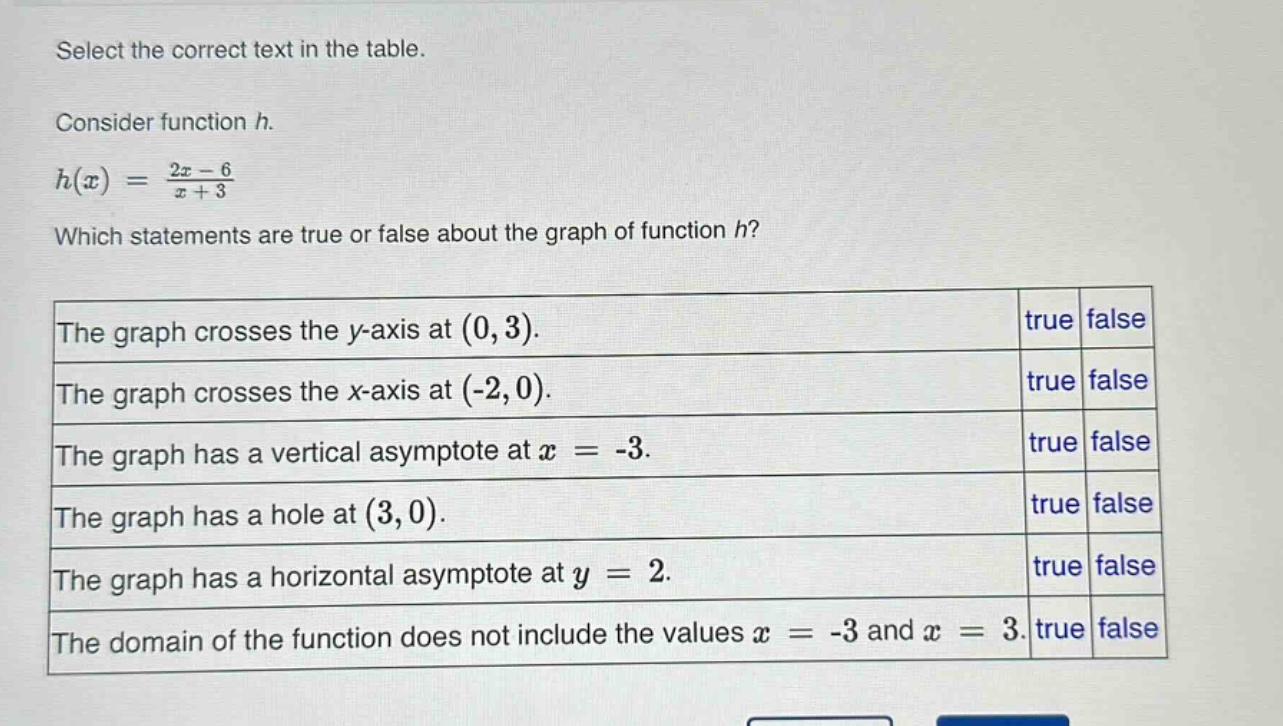
select the correct text in the table.\nconsider function h.\nh(x) = \\frac{2x - 6}{x + 3}\nwhich statements are true or false about the graph of function h?\nthe graph crosses the y - axis at (0, 3). true false\nthe graph crosses the x - axis at (-2, 0). true false\nthe graph has a vertical asymptote at x = -3. true false\nthe graph has a hole at (3, 0). true false\nthe graph has a horizontal asymptote at y = 2. true false\nthe domain of the function does not include the values x = -3 and x = 3. true false
Answer
Explanation:
Step1: Encontrar el intercepto en el eje (y)
Sustituir (x = 0) en (h(x)=\frac{2x - 6}{x + 3}). (h(0)=\frac{2\times0-6}{0 + 3}=\frac{-6}{3}=-2). Entonces, el intercepto en el eje (y) es ((0,-2)), por lo que la afirmación "The graph crosses the (y)-axis at ((0,3))" es falsa.
Step2: Encontrar el intercepto en el eje (x)
Igualar (h(x)=0), es decir (\frac{2x - 6}{x + 3}=0). Esto ocurre cuando (2x-6 = 0) (ya que el denominador no puede ser cero). Resolviendo (2x-6=0) se obtiene (x = 3). Entonces, el intercepto en el eje (x) es ((3,0)), por lo que la afirmación "The graph crosses the (x)-axis at ((-2,0))" es falsa.
Step3: Encontrar la asíntota vertical
La función (h(x)=\frac{2x - 6}{x + 3}) tiene una asíntota vertical cuando el denominador es cero. Si (x+3=0), entonces (x=-3). Entonces, la afirmación "The graph has a vertical asymptote at (x=-3)" es verdadera.
Step4: Verificar la presencia de un agujero
Factorizar la función: (h(x)=\frac{2(x - 3)}{x + 3}). No hay factores comunes en el numerador y el denominador (excepto 1), por lo que no hay agujeros. Entonces, la afirmación "The graph has a hole at ((3,0))" es falsa.
Step5: Encontrar la asíntota horizontal
Como el grado del numerador y del denominador es el mismo (grado 1), la asíntota horizontal es (y=\frac{\text{coeficiente principal del numerador}}{\text{coeficiente principal del denominador}}). Aquí, (y=\frac{2}{1}=2). Entonces, la afirmación "The graph has a horizontal asymptote at (y = 2)" es verdadera.
Step6: Encontrar el dominio
El dominio de (h(x)=\frac{2x - 6}{x + 3}) es todos los números reales excepto (x=-3) (ya que el denominador no puede ser cero). Entonces, la afirmación "The domain of the function does not include the values (x=-3) and (x = 3)" es falsa.
Answer:
| Statement | True/False |
|---|---|
| The graph crosses the (y)-axis at ((0,3)) | False |
| The graph crosses the (x)-axis at ((-2,0)) | False |
| The graph has a vertical asymptote at (x=-3) | True |
| The graph has a hole at ((3,0)) | False |
| The graph has a horizontal asymptote at (y = 2) | True |
| The domain of the function does not include the values (x=-3) and (x = 3) | False |