select the correct texts in the table.\nconsider function f.\n f(x)=\begin{cases}-\frac{1}{4}x^{2}+6x + 36…
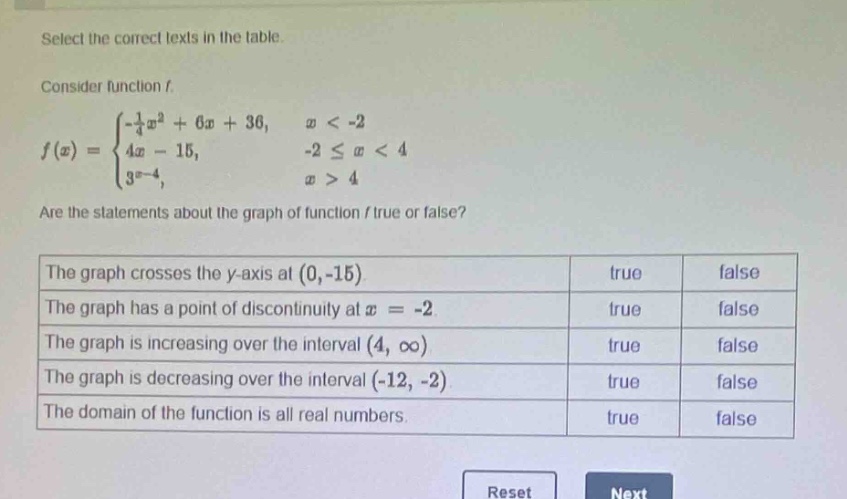
select the correct texts in the table.\nconsider function f.\n f(x)=\begin{cases}-\frac{1}{4}x^{2}+6x + 36, & x < - 2\\4x-15, & -2leq x < 4\\3^{x - 4}, & x>4end{cases}\nare the statements about the graph of function f true or false?\nthe graph crosses the y - axis at (0,-15). true false\nthe graph has a point of discontinuity at x=-2. true false\nthe graph is increasing over the interval (4,∞). true false\nthe graph is decreasing over the interval (-12,-2). true false\nthe domain of the function is all real numbers. true false
Answer
Explanation:
Step1: Find y - intercept
To find the y - intercept, set (x = 0). Since (- 2\leqslant0<4), use (f(x)=4x - 15). Substitute (x = 0) into (f(x)=4x - 15), we get (f(0)=4\times0-15=-15). So the graph crosses the y - axis at ((0, - 15)), this statement is true.
Step2: Check continuity at (x=-2)
Left - hand limit as (x\to - 2^{-}): (f(x)=-\frac{1}{4}x^{2}+6x + 36), (\lim_{x\to - 2^{-}}(-\frac{1}{4}x^{2}+6x + 36)=-\frac{1}{4}\times(-2)^{2}+6\times(-2)+36=- 1-12 + 36=23). Right - hand limit as (x\to - 2^{+}): (f(x)=4x - 15), (\lim_{x\to - 2^{+}}(4x - 15)=4\times(-2)-15=-8 - 15=-23). Since the left - hand limit and right - hand limit are not equal, the graph has a point of discontinuity at (x=-2), this statement is true.
Step3: Analyze the function for (x > 4)
For (x>4), (f(x)=3^{x - 4}). The exponential function (y = a^{x}) with (a>1) (here (a = 3)) is an increasing function. So (f(x)=3^{x - 4}) is increasing for (x\in(4,\infty)), this statement is true.
Step4: Analyze the function for (-12<x<-2)
For (x<-2), (f(x)=-\frac{1}{4}x^{2}+6x + 36). The derivative (f^\prime(x)=-\frac{1}{2}x + 6). Set (f^\prime(x)=0), we get (x = 12). The coefficient of (x^{2}) is negative ((-\frac{1}{4}<0[Client Connection Error]