select the correct texts in the table.\nconsider function f.\n$$ f ( x ) = left{ \begin{array} { l l } {…
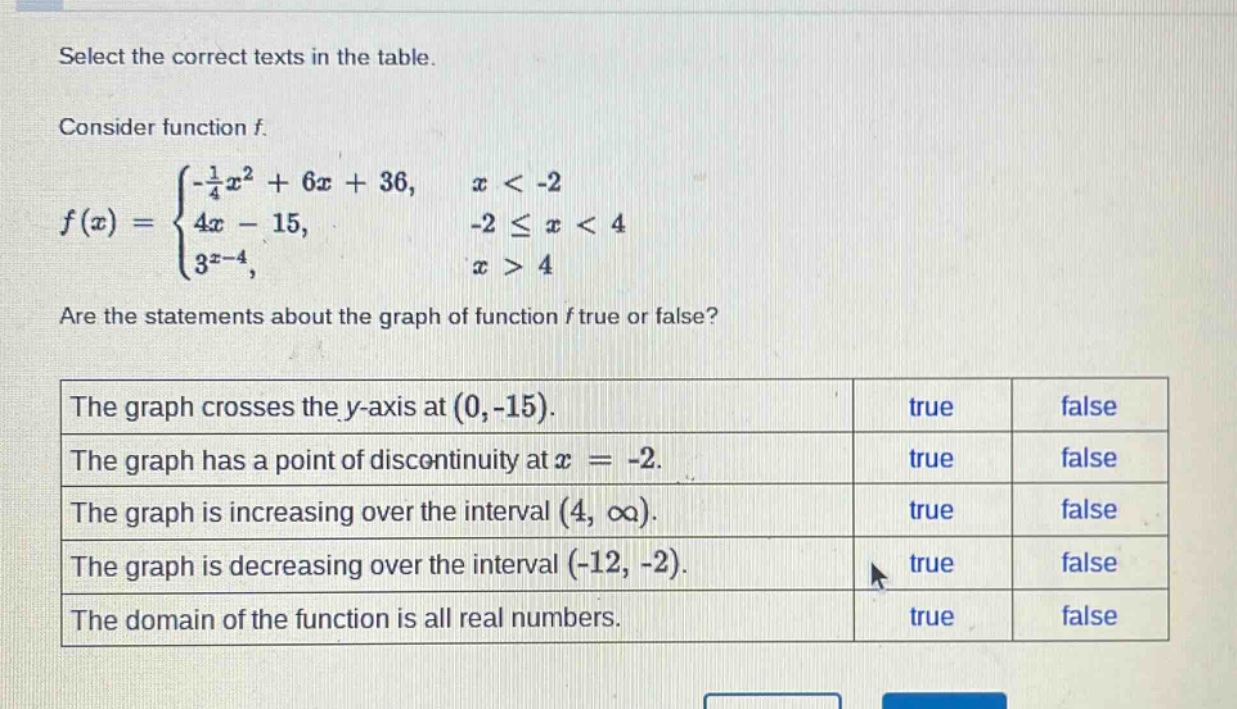
select the correct texts in the table.\nconsider function f.\n$$ f ( x ) = left{ \begin{array} { l l } { - \frac { 1 } { 4 } x ^ { 2 } + 6 x + 36, } & { x < - 2 } \\ { 4 x - 15, } & { - 2 leq x < 4 } \\ { 3 ^ { x - 4 }, } & { x > 4 } end{array} \right. $$\nare the statements about the graph of function f true or false?\n| the graph crosses the y - axis at $$ ( 0, - 15 ) $$. | true | false |\n| the graph has a point of discontinuity at $$ x = - 2 $$. | true | false |\n| the graph is increasing over the interval $$ ( 4, infty ) $$. | true | false |\n| the graph is decreasing over the interval $$ ( - 12, - 2 ) $$. | true | false |\n| the domain of the function is all real numbers. | true | false |
Answer
Answer:
- The graph crosses the (y) - axis at ((0, - 15)): true
- The graph has a point of discontinuity at (x=-2): false
- The graph is increasing over the interval ((4,\infty)): true
- The graph is decreasing over the interval ((-12,-2)): false
- The domain of the function is all real numbers: true
Explanation:
Step1: Check (y) - intercept
For (x = 0), since (-2\leqslant0\lt4), we use (y = 4x-15). Substitute (x = 0) into (y=4x - 15), we get (y=4\times0-15=-15). So the graph crosses the (y) - axis at ((0,-15)) (True).
Step2: Check continuity at (x=-2)
Left - hand limit: (\lim_{x\rightarrow - 2^{-}}f(x)=\lim_{x\rightarrow - 2^{-}}\left(-\frac{1}{4}x^{2}+6x + 36\right)) Substitute (x=-2) into (-\frac{1}{4}x^{2}+6x + 36): (-\frac{1}{4}\times(-2)^{2}+6\times(-2)+36=-1 - 12 + 36=23) Right - hand limit: (\lim_{x\rightarrow - 2^{+}}f(x)=\lim_{x\rightarrow - 2^{+}}(4x-15)) Substitute (x=-2) into (4x - 15): (4\times(-2)-15=-8-15=-23) Since (\lim_{x\rightarrow - 2^{-}}f(x)\neq\lim_{x\rightarrow - 2^{+}}f(x)), but we should also check the value of the function. The function is defined as (y = 4x-15) for (-2\leqslant x\lt4), (f(-2)=4\times(-2)-15=-23). The left - hand side function (-\frac{1}{4}x^{2}+6x + 36) is for (x\lt - 2). There is no hole or break in the sense of the function's definition (the two - sided limit not existing is because of the different function rules, but the function is well - defined at (x=-2) as per its piece - wise definition). So the graph is not discontinuous at (x =-2) (False).
Step3: Check the behavior of (y = 3^{x - 4}) for (x>4)
The function (y=a^{x}) with (a>1) (here (a = 3)) is an exponential growth function. For (y = 3^{x-4}), when (x>4), as (x) increases, (y) increases. So the graph is increasing over the interval ((4,\infty)) (True).
Step4: Check the behavior of (y=-\frac{1}{4}x^{2}+6x + 36) for (x\lt - 2)
The function (y=ax^{2}+bx + c) ((a=-\frac{1}{4}\lt0)) has the axis of symmetry (x=-\frac{b}{2a}=-\frac{6}{2\times(-\frac{1}{4})}=12). The function (y =-\frac{1}{4}x^{2}+6x + 36) is a parabola opening downwards. The function is increasing on the interval ((-\infty,12)) and decreasing on ((12,\infty)). For the interval ((-12,-2)), since (-12\lt - 2\lt12), the function (y=-\frac{1}{4}x^{2}+6x + 36) is increasing on ((-12,-2)) (False).
Step5: Check the domain
The first piece (y=-\frac{1}{4}x^{2}+6x + 36) is defined for (x\lt - 2), the second piece (y = 4x-15) is defined for (-2\leqslant x\lt4), and the third piece (y=3^{x - 4}) is defined for (x>4). Combining these, the domain is all real numbers (True).