select the true statements.\nwhen x ≈ 8, the value of h(x) exceeds the values of both f(x) and g(x).\nwhen x…
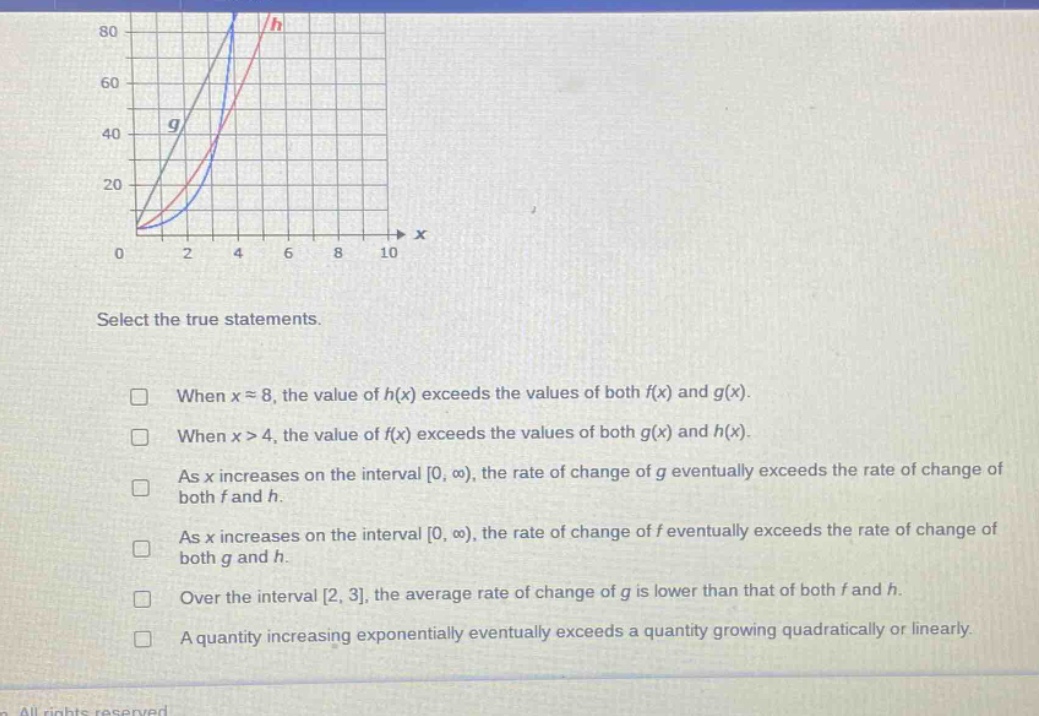
select the true statements.\nwhen x ≈ 8, the value of h(x) exceeds the values of both f(x) and g(x).\nwhen x > 4, the value of f(x) exceeds the values of both g(x) and h(x).\nas x increases on the interval 0, ∞), the rate of change of g eventually exceeds the rate of change of both f and h.\nas x increases on the interval 0, ∞), the rate of change of f eventually exceeds the rate of change of both g and h.\nover the interval 2, 3, the average rate of change of g is lower than that of both f and h.\na quantity increasing exponentially eventually exceeds a quantity growing quadratically or linearly.
Answer
Explanation:
Step1: Analizar la gráfica para (x \approx 8)
Observando la gráfica, cuando (x\approx8), la curva (h(x)) está por encima de (f(x)) y (g(x)). Entonces la afirmación "When (x\approx8), the value of (h(x)) exceeds the values of both (f(x)) and (g(x))" es verdadera.
Step2: Analizar la gráfica para (x > 4)
Para (x > 4), no se cumple que (f(x)) esté por encima de (g(x)) y (h(x)) en todo el rango, entonces "When (x > 4), the value of (f(x)) exceeds the values of both (g(x)) and (h(x))" es falsa.
Step3: Analizar las tasas de cambio
La función (g(x)) es lineal, mientras que (f(x)) y (h(x)) son funciones no - lineales crecientes más rápidamente a largo plazo. Entonces la tasa de cambio de (g) no superará a la de (f) y (h) en ([0,\infty)), la afirmación "As (x) increases on the interval ([0,\infty)), the rate of change of (g) eventually exceeds the rate of change of both (f) and (h)" es falsa.
Step4: Analizar las tasas de cambio de (f)
La función (f(x)) no superará a la de (h(x)) en ([0,\infty)) ya que (h(x)) parece crecer más rápidamente a largo plazo, entonces "As (x) increases on the interval ([0,\infty)), the rate of change of (f) eventually exceeds the rate of change of both (g) and (h)" es falsa.
Step5: Analizar la tasa de cambio promedio en ([2,3])
En el intervalo ([2,3]), la pendiente de (g) es mayor que la pendiente de (f) y (h), es decir, el promedio de cambio de (g) es mayor que el de (f) y (h), entonces "Over the interval ([2,3]), the average rate of change of (g) is lower than that of both (f) and (h)" es falsa.
Step6: Teoría general
Un cantidad que crece exponencialmente eventualmente supera a una cantidad que crece lineal o cuadráticamente, entonces "A quantity increasing exponentially eventually exceeds a quantity growing quadratically or linearly" es verdadera.
Answer:
When (x\approx8), the value of (h(x)) exceeds the values of both (f(x)) and (g(x)); A quantity increasing exponentially eventually exceeds a quantity growing quadratically or linearly.