selected the correct answer. the graph of function ( f ) is shown. function ( g ) is represented by this…
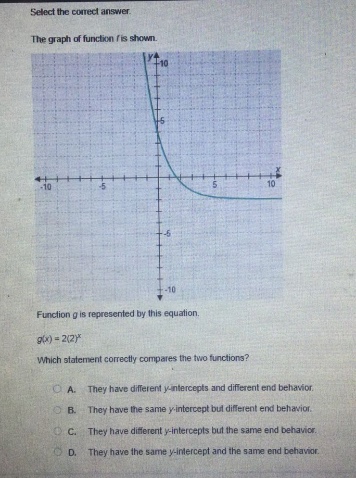
selected the correct answer. the graph of function ( f ) is shown. function ( g ) is represented by this equation. ( g(x)=2(2)^{x} ). which statement correctly compares the two functions? a. they have different ( y )-intercepts and different end - behavior. b. they have the same ( y )-intercept but different end - behavior. c. they have different ( y )-intercepts but the same end - behavior. d. they have the same ( y )-intercept and the same end - behavior.
Answer
Explanation:
Step1: Find the y - intercept of function f
The y - intercept of a function is the value of the function when x = 0. From the graph of function f, when x = 0, y = 8.
Step2: Find the y - intercept of function g
For the function g(x)=2(2)^x, when x = 0, g(0)=2(2)^0. Since any non - zero number to the power of 0 is 1, g(0)=2×1 = 2. So the y - intercept of g is 2.
Step3: Analyze the end - behavior of function f
As x→+∞, the graph of f(x) approaches 0. As x→ - ∞, the graph of f(x) approaches +∞.
Step4: Analyze the end - behavior of function g
For the exponential function g(x)=2(2)^x, as x→+∞, g(x)→+∞ (because the base 2>1 and the coefficient 2>0). As x→ - ∞, g(x)=2(2)^x = 2×(1/2)^(-x)→0. Since the y - intercepts (8 and 2) are different and the end - behaviors are different.
Answer:
A. They have different y - intercepts and different end behavior.