selected values of a function f and its first three derivatives are indicated in the table above. what is…
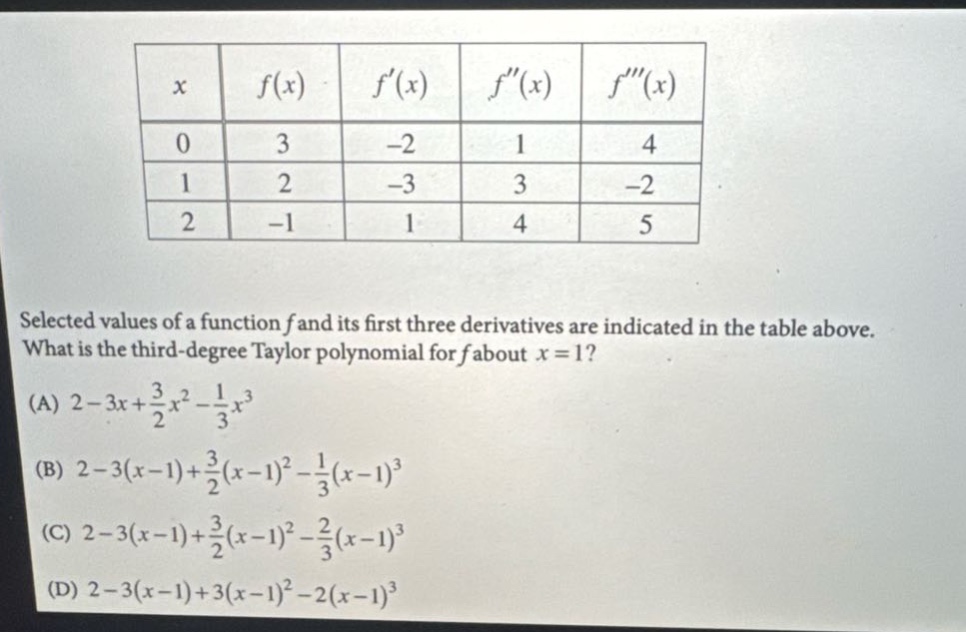
selected values of a function f and its first three derivatives are indicated in the table above. what is the third - degree taylor polynomial for f about x = 1? (a) 2 - 3x + 3/2 x^2 - 1/3 x^3 (b) 2 - 3(x - 1)+3/2 (x - 1)^2 - 1/3 (x - 1)^3 (c) 2 - 3(x - 1)+3/2 (x - 1)^2 - 2/3 (x - 1)^3 (d) 2 - 3(x - 1)+3(x - 1)^2 - 2(x - 1)^3
Answer
Explanation:
Step1: Recall Taylor - polynomial formula
The third - degree Taylor polynomial of a function $f(x)$ about $x = a$ is given by $P_3(x)=f(a)+f^{\prime}(a)(x - a)+\frac{f^{\prime\prime}(a)}{2!}(x - a)^2+\frac{f^{\prime\prime\prime}(a)}{3!}(x - a)^3$.
Step2: Identify the value of $a$
We are finding the Taylor polynomial about $x = 1$, so $a = 1$.
Step3: Find $f(a)$, $f^{\prime}(a)$, $f^{\prime\prime}(a)$ and $f^{\prime\prime\prime}(a)$
From the table, when $a = 1$, $f(1)=2$, $f^{\prime}(1)=-3$, $f^{\prime\prime}(1)=3$, $f^{\prime\prime\prime}(1)=-2$.
Step4: Substitute values into the formula
$P_3(x)=f(1)+f^{\prime}(1)(x - 1)+\frac{f^{\prime\prime}(1)}{2}(x - 1)^2+\frac{f^{\prime\prime\prime}(1)}{6}(x - 1)^3$. Substitute $f(1)=2$, $f^{\prime}(1)=-3$, $f^{\prime\prime}(1)=3$, $f^{\prime\prime\prime}(1)=-2$ into the above formula: $P_3(x)=2-3(x - 1)+\frac{3}{2}(x - 1)^2-\frac{2}{6}(x - 1)^3=2-3(x - 1)+\frac{3}{2}(x - 1)^2-\frac{1}{3}(x - 1)^3$.
Answer:
B. $2-3(x - 1)+\frac{3}{2}(x - 1)^2-\frac{1}{3}(x - 1)^3$