does the sequence {an} converge or diverge? find the limit if the sequence is convergent. an = ln(n + 1) /…
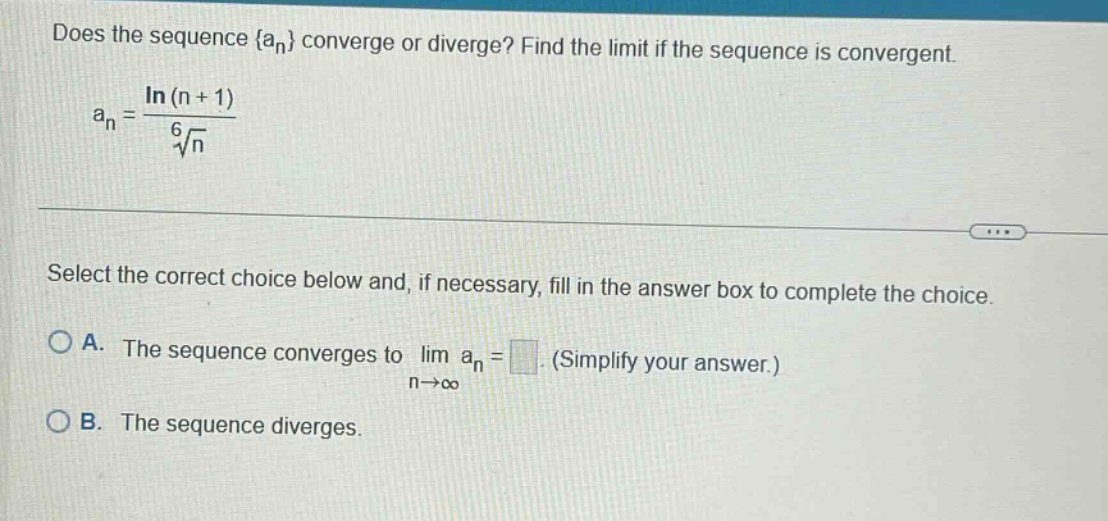
does the sequence {an} converge or diverge? find the limit if the sequence is convergent. an = ln(n + 1) / 6√n select the correct choice below and, if necessary, fill in the answer box to complete the choice. a. the sequence converges to lim an = (simplify your answer.) n→∞ b. the sequence diverges.
Answer
Explanation:
Step1: Apply L'Hopital's rule
We have $\lim_{n\rightarrow\infty}\frac{\ln(n + 1)}{\sqrt[6]{n}}$, which is in the $\frac{\infty}{\infty}$ form. By L'Hopital's rule, if $\lim_{x\rightarrow a}\frac{f(x)}{g(x)}$ is in the $\frac{\infty}{\infty}$ or $\frac{0}{0}$ form, then $\lim_{x\rightarrow a}\frac{f(x)}{g(x)}=\lim_{x\rightarrow a}\frac{f'(x)}{g'(x)}$. The derivative of $y = \ln(n + 1)$ is $y'=\frac{1}{n + 1}$, and the derivative of $y=\sqrt[6]{n}=n^{\frac{1}{6}}$ is $y'=\frac{1}{6}n^{-\frac{5}{6}}$. So, $\lim_{n\rightarrow\infty}\frac{\ln(n + 1)}{\sqrt[6]{n}}=\lim_{n\rightarrow\infty}\frac{\frac{1}{n + 1}}{\frac{1}{6}n^{-\frac{5}{6}}}=\lim_{n\rightarrow\infty}\frac{6n^{\frac{5}{6}}}{n + 1}$.
Step2: Analyze the new - formed limit
The limit $\lim_{n\rightarrow\infty}\frac{6n^{\frac{5}{6}}}{n + 1}$ is still in the $\frac{\infty}{\infty}$ form. We can divide both the numerator and denominator by $n$. We get $\lim_{n\rightarrow\infty}\frac{6n^{-\frac{1}{6}}}{1+\frac{1}{n}}$.
Step3: Evaluate the limit
As $n\rightarrow\infty$, $\frac{1}{n}\rightarrow0$ and $n^{-\frac{1}{6}}=\frac{1}{n^{\frac{1}{6}}}\rightarrow0$. So, $\lim_{n\rightarrow\infty}\frac{6n^{-\frac{1}{6}}}{1+\frac{1}{n}} = 0$.
Answer:
A. The sequence converges to $\lim_{n\rightarrow\infty}a_{n}=0$