does the series below converge or diverge? give a reason for your answer. \n∑_{n = 1}^{∞} 5e^{4n}/(1 +…
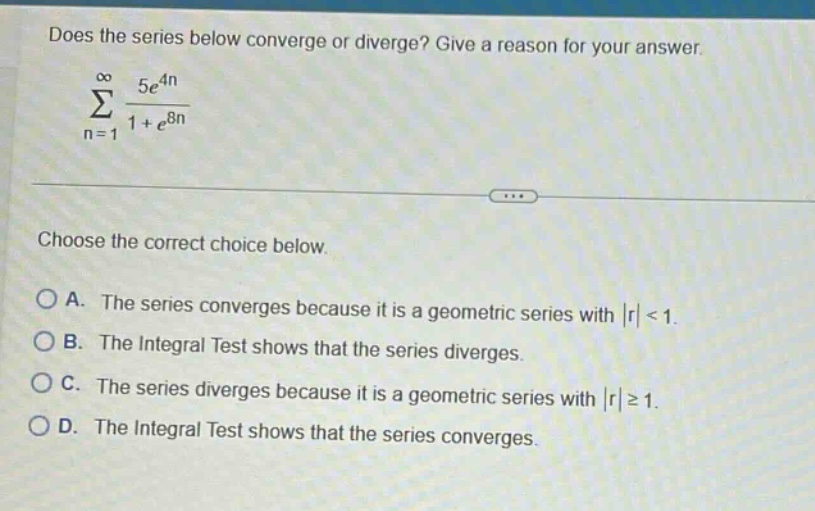
does the series below converge or diverge? give a reason for your answer. \n∑_{n = 1}^{∞} 5e^{4n}/(1 + e^{8n})\nchoose the correct choice below.\na. the series converges because it is a geometric series with |r| < 1.\nb. the integral test shows that the series diverges.\nc. the series diverges because it is a geometric series with |r| ≥ 1.\nd. the integral test shows that the series converges.
Answer
Explanation:
Step1: Apply the Integral Test
Let (f(n)=\frac{5e^{4n}}{1 + e^{8n}}). Consider the function (f(x)=\frac{5e^{4x}}{1 + e^{8x}}) for (x\geq1). The function (f(x)) is positive, continuous and decreasing for (x\geq1). We can use the substitution (u = e^{4x}), then (du=4e^{4x}dx).
Step2: Rewrite the integral
(\int_{1}^{\infty}\frac{5e^{4x}}{1 + e^{8x}}dx=\frac{5}{4}\int_{e^{4}}^{\infty}\frac{du}{1 + u^{2}}).
Step3: Evaluate the integral
We know that (\int\frac{du}{1 + u^{2}}=\arctan(u)+C). So (\frac{5}{4}\int_{e^{4}}^{\infty}\frac{du}{1 + u^{2}}=\frac{5}{4}\lim_{b\rightarrow\infty}(\arctan(u)\big|{e^{4}}^{b})=\frac{5}{4}\lim{b\rightarrow\infty}(\arctan(b)-\arctan(e^{4}))). Since (\lim_{b\rightarrow\infty}\arctan(b)=\frac{\pi}{2}), then (\frac{5}{4}\lim_{b\rightarrow\infty}(\arctan(b)-\arctan(e^{4}))=\frac{5}{4}(\frac{\pi}{2}-\arctan(e^{4}))), which is a finite - value.
Answer:
D. The Integral Test shows that the series converges.