the shaded region shown below is bounded by the functions f(x)=−2x²−0.5x + 9 and g(x)=−1.75x + 7 and the…
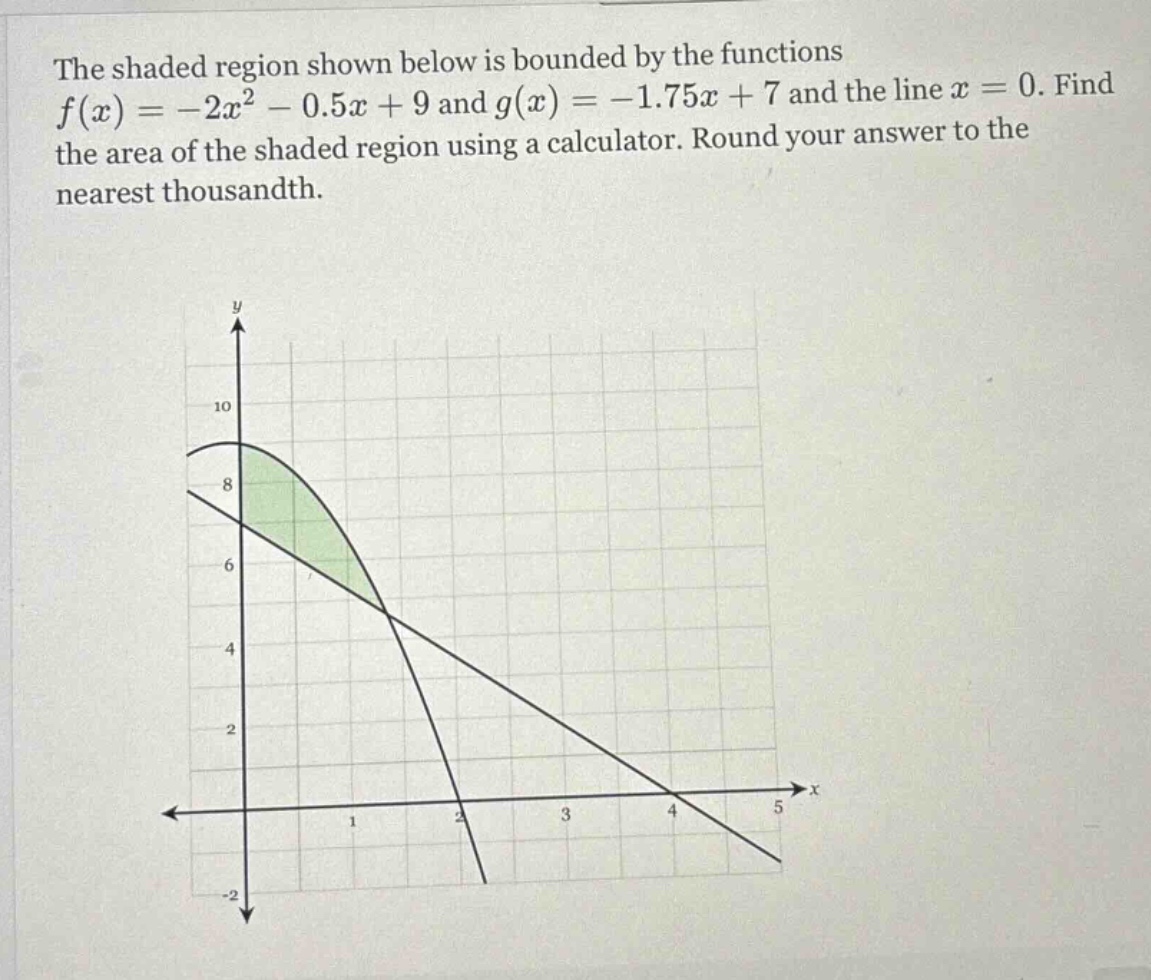
the shaded region shown below is bounded by the functions f(x)=−2x²−0.5x + 9 and g(x)=−1.75x + 7 and the line x = 0. find the area of the shaded region using a calculator. round your answer to the nearest thousandth.
Answer
Explanation:
Step1: Find intersection point
Set $f(x)=g(x)$, so $-2x^{2}-0.5x + 9=-1.75x + 7$. Rearrange to get $-2x^{2}+1.25x + 2 = 0$. Using the quadratic formula $x=\frac{-b\pm\sqrt{b^{2}-4ac}}{2a}$ with $a=-2$, $b = 1.25$, $c = 2$, we find the positive root (since we are interested in the region starting from $x = 0$).
Step2: Set up integral for area
The area $A$ between two curves $y = f(x)$ and $y = g(x)$ from $x=a$ to $x=b$ is given by $A=\int_{a}^{b}[f(x)-g(x)]dx$. Here $a = 0$ and $b$ is the intersection - point $x$ value. $f(x)-g(x)=-2x^{2}-0.5x + 9-(-1.75x + 7)=-2x^{2}+1.25x + 2$. So $A=\int_{0}^{b}(-2x^{2}+1.25x + 2)dx$.
Step3: Evaluate integral
Using the power - rule for integration $\int x^{n}dx=\frac{x^{n + 1}}{n+1}+C(n\neq - 1)$, we have $\int(-2x^{2}+1.25x + 2)dx=-2\times\frac{x^{3}}{3}+1.25\times\frac{x^{2}}{2}+2x+C$. Evaluate from $0$ to $b$. Let's first solve $-2x^{2}+1.25x + 2 = 0$. Using the quadratic formula $x=\frac{-1.25\pm\sqrt{(1.25)^{2}-4\times(-2)\times2}}{2\times(-2)}=\frac{-1.25\pm\sqrt{1.5625 + 16}}{-4}=\frac{-1.25\pm\sqrt{17.5625}}{-4}$. The positive root is $x=\frac{-1.25+\sqrt{17.5625}}{-4}\approx1.25$. Now, $A=\left[- \frac{2}{3}x^{3}+\frac{1.25}{2}x^{2}+2x\right]_{0}^{1.25}=-\frac{2}{3}(1.25)^{3}+\frac{1.25}{2}(1.25)^{2}+2(1.25)$. $A=-\frac{2}{3}\times1.953125+\frac{1.25}{2}\times1.5625 + 2.5$. $A=-\ 1.302083+0.9765625 + 2.5$. $A\approx2.175$.
Answer:
$2.175$