the shaded region shown below is bounded by the functions f(x)=-4x² + 9 and g(x)=2.75x + 3, the y - axis and…
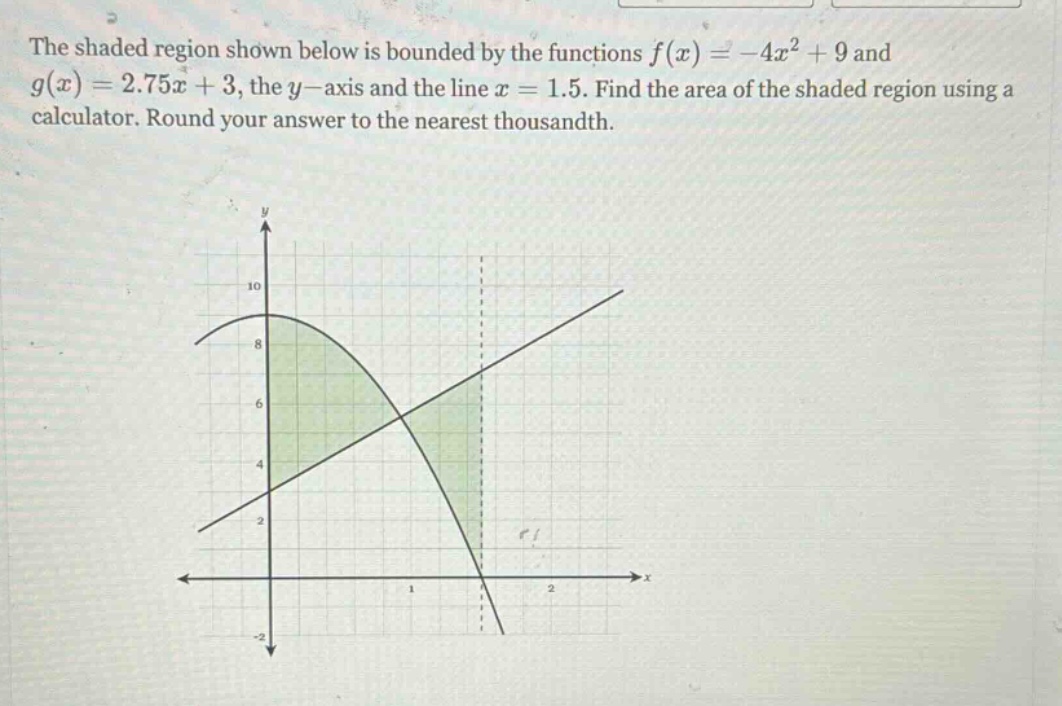
the shaded region shown below is bounded by the functions f(x)=-4x² + 9 and g(x)=2.75x + 3, the y - axis and the line x = 1.5. find the area of the shaded region using a calculator. round your answer to the nearest thousandth.
Answer
Explanation:
Step1: Determine the upper - lower functions
On the interval $[0,1.5]$, we need to find which function is on the top. Let's find the difference $h(x)=f(x)-g(x)=-4x^{2}-2.75x + 6$. We can also test a value in the interval, say $x = 0.5$. $f(0.5)=-4\times(0.5)^{2}+9=- 4\times0.25 + 9=8$, $g(0.5)=2.75\times0.5+3=1.375 + 3=4.375$. So $f(x)\geq g(x)$ on $[0,1.5]$.
Step2: Use the area formula
The area $A$ between two curves $y = f(x)$ and $y = g(x)$ from $x=a$ to $x = b$ is given by $A=\int_{a}^{b}[f(x)-g(x)]dx$. Here, $a = 0$, $b = 1.5$, $f(x)=-4x^{2}+9$ and $g(x)=2.75x + 3$. So $A=\int_{0}^{1.5}(-4x^{2}-2.75x + 6)dx$.
Step3: Integrate term - by - term
We know that $\int(-4x^{2}-2.75x + 6)dx=-4\times\frac{x^{3}}{3}-2.75\times\frac{x^{2}}{2}+6x+C=-\frac{4}{3}x^{3}-\frac{11}{8}x^{2}+6x+C$.
Step4: Evaluate the definite integral
$A=\left[-\frac{4}{3}x^{3}-\frac{11}{8}x^{2}+6x\right]_{0}^{1.5}$. $A=-\frac{4}{3}(1.5)^{3}-\frac{11}{8}(1.5)^{2}+6\times1.5-(0)$. $A=-\frac{4}{3}\times3.375-\frac{11}{8}\times2.25 + 9$. $A=-4.5-\frac{24.75}{8}+9$. $A=-4.5 - 3.09375+9$. $A=1.40625\approx1.406$.
Answer:
$1.406$