the shaded region shown below is bounded by the functions f(x)=−4x² + 9 and g(x)=−0.75x + 6, the y−axis and…
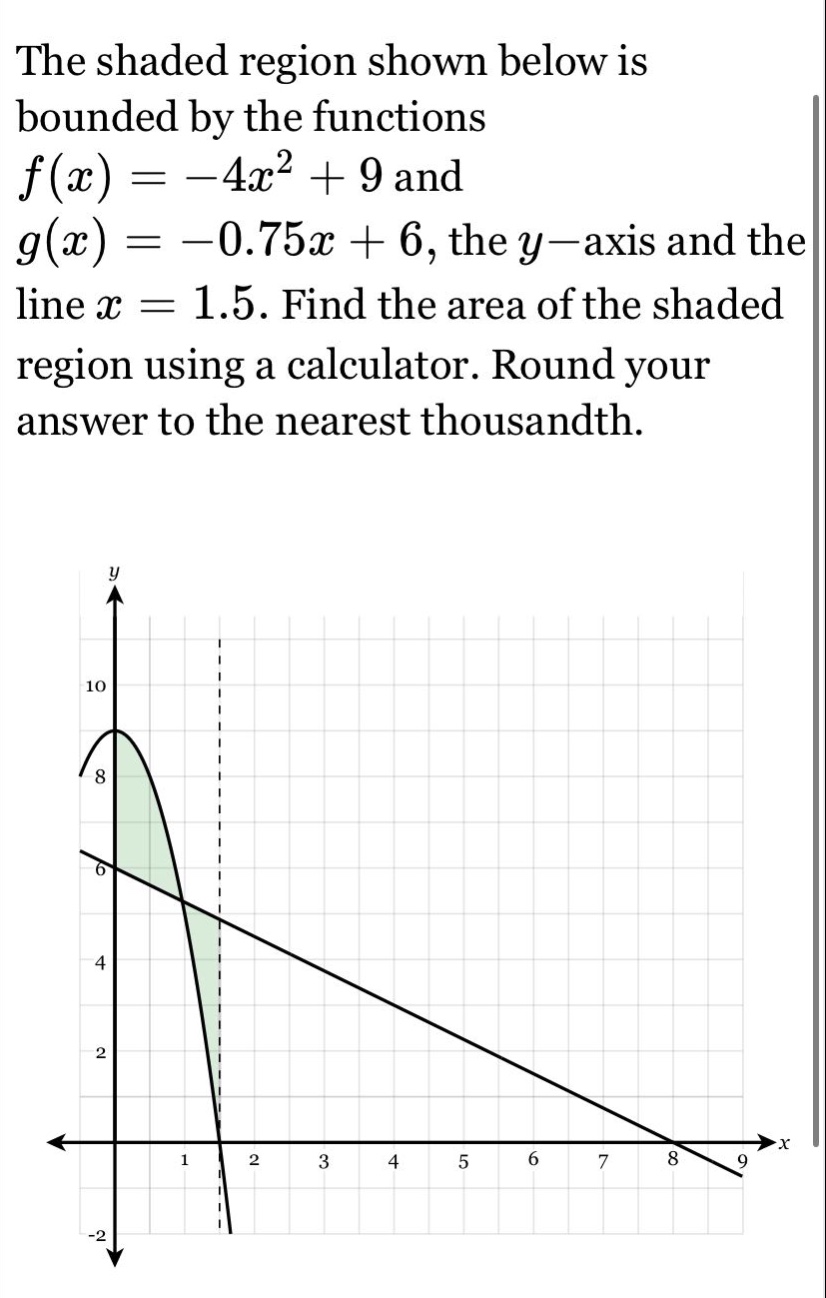
the shaded region shown below is bounded by the functions f(x)=−4x² + 9 and g(x)=−0.75x + 6, the y−axis and the line x = 1.5. find the area of the shaded region using a calculator. round your answer to the nearest thousandth.
Answer
Explanation:
Step1: Set up the integral
The area $A$ between two curves $y = f(x)$ and $y = g(x)$ from $x=a$ to $x = b$ is given by $A=\int_{a}^{b}|f(x)-g(x)|dx$. Here, $f(x)=- 4x^{2}+9$, $g(x)=-0.75x + 6$, $a = 0$ and $b=1.5$. Since $f(x)\geq g(x)$ on the interval $[0,1.5]$, the area formula becomes $A=\int_{0}^{1.5}((-4x^{2}+9)-(-0.75x + 6))dx=\int_{0}^{1.5}(-4x^{2}+0.75x + 3)dx$.
Step2: Integrate term - by - term
Using the power rule for integration $\int x^{n}dx=\frac{x^{n + 1}}{n+1}+C$ ($n\neq - 1$), we have: $\int(-4x^{2}+0.75x + 3)dx=-4\times\frac{x^{3}}{3}+0.75\times\frac{x^{2}}{2}+3x+C=-\frac{4}{3}x^{3}+\frac{3}{8}x^{2}+3x+C$.
Step3: Evaluate the definite integral
$A=\left[-\frac{4}{3}x^{3}+\frac{3}{8}x^{2}+3x\right]_{0}^{1.5}$. First, substitute $x = 1.5$: $-\frac{4}{3}(1.5)^{3}+\frac{3}{8}(1.5)^{2}+3(1.5)=-\frac{4}{3}\times3.375+\frac{3}{8}\times2.25 + 4.5$. $=-4.5+\frac{6.75}{8}+4.5$. $=\frac{6.75}{8}=0.84375$. Then substitute $x = 0$ (which gives $0$). So $A = 0.844$ (rounded to the nearest thousandth).
Answer:
$0.844$