show above is a slope field for the differential equation dy/dx = y²(4 - y²). if y = g(x) is the solution to…
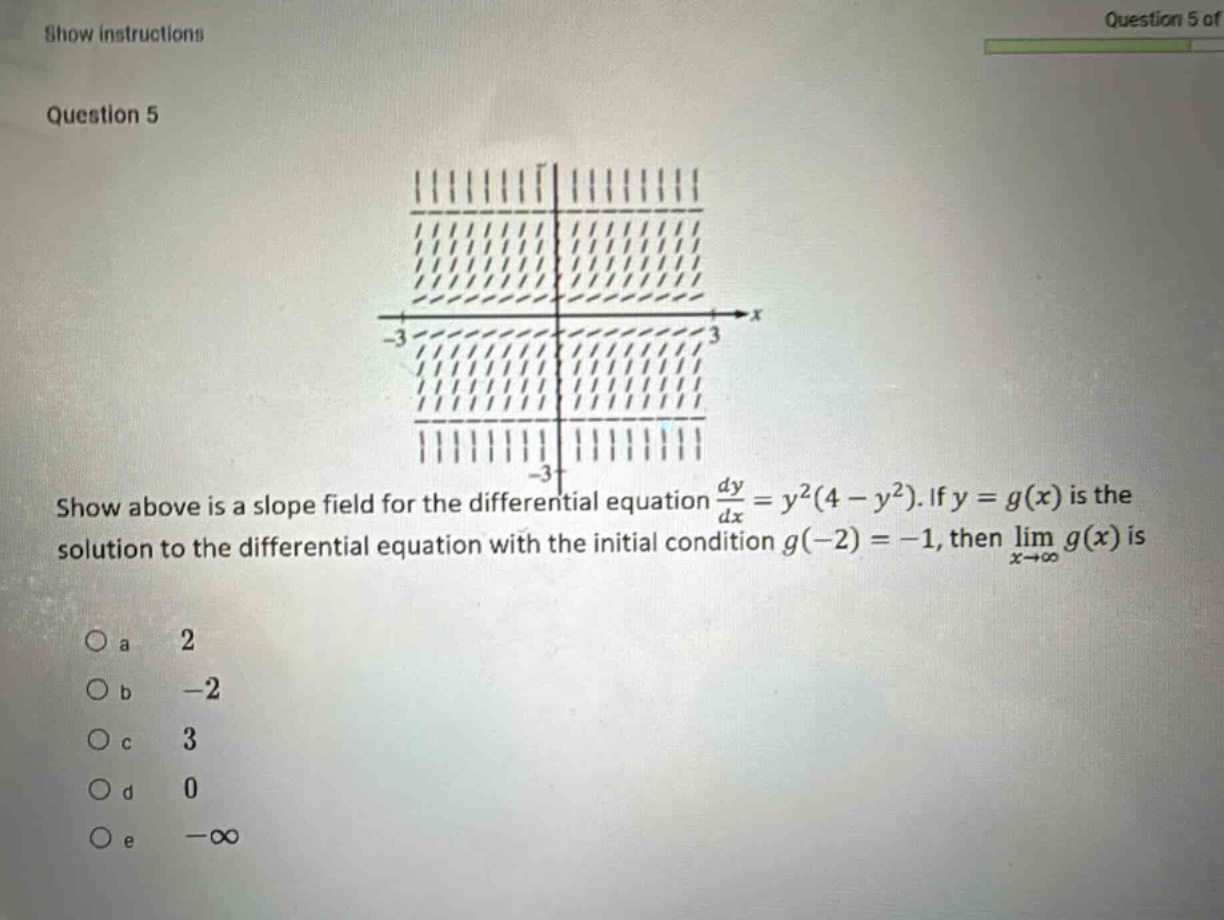
show above is a slope field for the differential equation dy/dx = y²(4 - y²). if y = g(x) is the solution to the differential equation with the initial condition g(-2) = -1, then lim(x→∞) g(x) is\no a 2\no b -2\no c 3\no d 0\no e -∞
Answer
Explanation:
Step1: Find equilibrium solutions
Set $\frac{dy}{dx}=y^{2}(4 - y^{2})=0$. Then $y^{2}(2 - y)(2 + y)=0$. The equilibrium - solutions are $y = 0$, $y = 2$, and $y=-2$.
Step2: Analyze the sign of $\frac{dy}{dx}$ in intervals
Consider the intervals:
- When $y\lt - 2$, $\frac{dy}{dx}=y^{2}(4 - y^{2})\lt0$ (since $y^{2}\gt0$ and $4 - y^{2}\lt0$).
- When $-2\lt y\lt0$, $\frac{dy}{dx}=y^{2}(4 - y^{2})\gt0$ (since $y^{2}\gt0$ and $4 - y^{2}\gt0$).
- When $0\lt y\lt2$, $\frac{dy}{dx}=y^{2}(4 - y^{2})\gt0$.
- When $y\gt2$, $\frac{dy}{dx}=y^{2}(4 - y^{2})\lt0$.
Step3: Use the initial condition
We have the initial condition $g(-2)=-1$. Since $\frac{dy}{dx}\gt0$ for $-2\lt y\lt0$, the function $y = g(x)$ is increasing when $y$ is in the interval $(-2,0)$. As $x\to\infty$, the function $y = g(x)$ will approach the nearest equilibrium solution in the direction of its growth. The nearest equilibrium solution for an increasing function starting from $y=-1$ is $y = 0$.
Answer:
d. 0