show all work used to answer each question. 1. if the price of each ticket to a concert is $16, a total of…
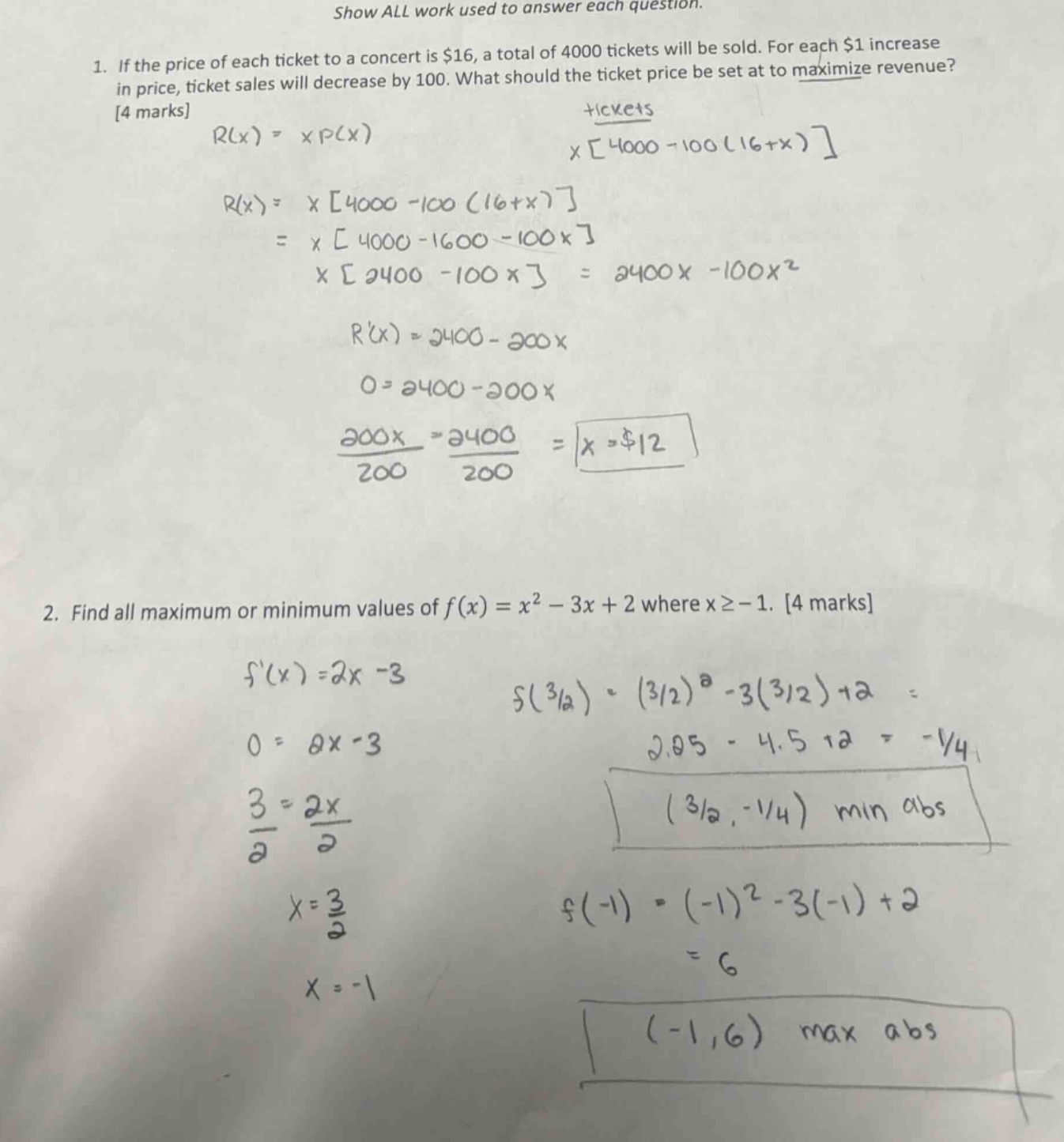
show all work used to answer each question. 1. if the price of each ticket to a concert is $16, a total of 4000 tickets will be sold. for each $1 increase in price, ticket sales will decrease by 100. what should the ticket price be set at to maximize revenue? 4 marks r(x)=x*p(x) x4000 - 100(16 + x) r(x)=x4000 - 100(16 + x) = x4000 - 1600 - 100x x2400 - 100x=2400x - 100x^2 r(x)=2400 - 200x 0 = 2400 - 200x 200x/200=2400/200 = x = $12 2. find all maximum or minimum values of f(x)=x^2 - 3x + 2 where x≥ - 1. 4 marks f(x)=2x - 3 f(3/2)=(3/2)^2 - 3(3/2)+2 = 2.25 - 4.5 + 2=-1/4 0 = 2x - 3 3/2=2x/2 x = 3/2 (-1,6) max abs (3/2,-1/4) min abs f(-1)=(-1)^2 - 3(-1)+2 = 6 x=-1
Answer
Explanation:
Step1: Define revenue function for concert tickets
Let $x$ be the number of $1 - price - increases. The price per ticket is $p(x)=16 + x$, and the number of tickets sold is $n(x)=4000-100x$. The revenue function $R(x)$ is the product of the price per ticket and the number of tickets sold, so $R(x)=(16 + x)(4000-100x)=4000x-100x^{2}+64000 - 1600x=-100x^{2}+2400x + 64000$.
Step2: Find the derivative of the revenue function
Using the power - rule $\frac{d}{dx}(ax^{n})=nax^{n - 1}$, we have $R^\prime(x)=\frac{d}{dx}(-100x^{2}+2400x + 64000)=-200x + 2400$.
Step3: Set the derivative equal to zero and solve for $x$
Set $R^\prime(x)=0$, so $-200x + 2400 = 0$. Then $200x=2400$, and $x = 12$. The ticket price should be $16 + 12=$28$.
Step4: Analyze the function $f(x)=x^{2}-3x + 2$
First, find the derivative $f^\prime(x)=\frac{d}{dx}(x^{2}-3x + 2)=2x-3$.
Step5: Find the critical points
Set $f^\prime(x)=0$, so $2x-3 = 0$, and $x=\frac{3}{2}$.
Step6: Evaluate the function at the critical point and the endpoint
Evaluate $f(x)$ at $x=\frac{3}{2}$: $f(\frac{3}{2})=(\frac{3}{2})^{2}-3\times\frac{3}{2}+2=\frac{9}{4}-\frac{9}{2}+2=\frac{9 - 18 + 8}{4}=-\frac{1}{4}$. Evaluate $f(x)$ at $x=-1$: $f(-1)=(-1)^{2}-3\times(-1)+2=1 + 3+2=6$. Since $x\geq - 1$, the absolute minimum value of $f(x)$ is $-\frac{1}{4}$ at $x = \frac{3}{2}$, and the absolute maximum value is $6$ at $x=-1$.
Answer:
- The ticket price should be set at $$28$ to maximize revenue.
- The absolute minimum value of $f(x)$ is $-\frac{1}{4}$ at $x=\frac{3}{2}$, and the absolute maximum value is $6$ at $x=-1$.