. shown above is a slope field for which of the following differential equations? (a) dy/dx = xy - x (b)…
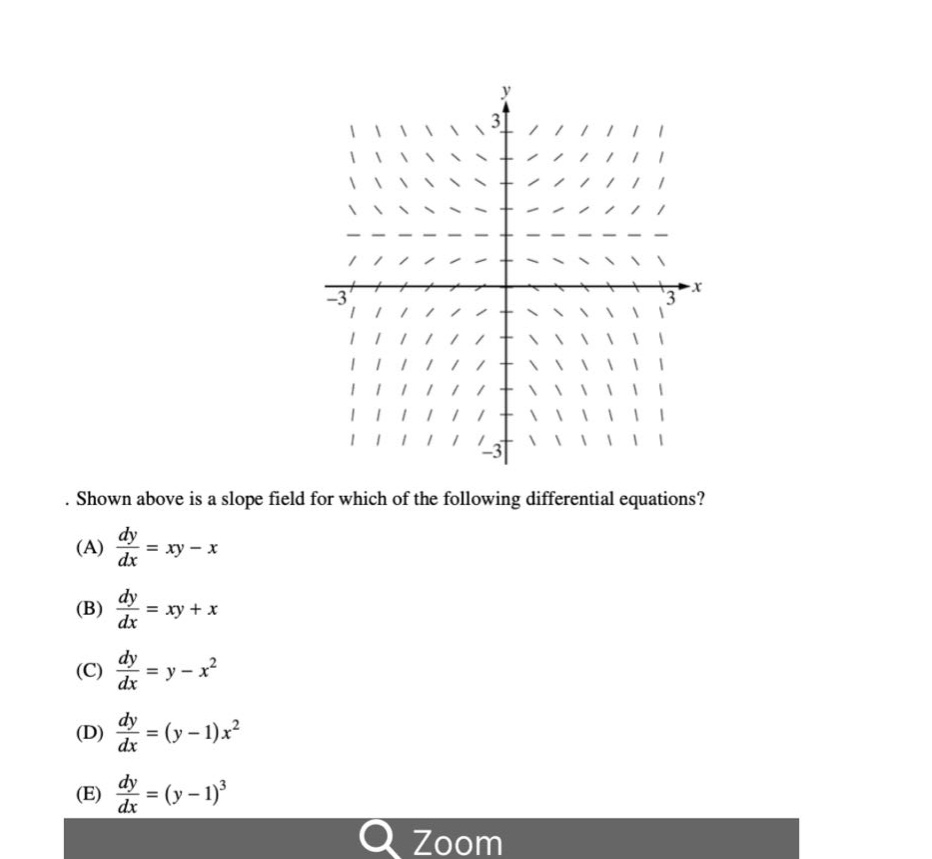
. shown above is a slope field for which of the following differential equations? (a) dy/dx = xy - x (b) dy/dx = xy + x (c) dy/dx = y - x^2 (d) dy/dx = (y - 1)x^2 (e) dy/dx = (y - 1)^3
Answer
Explanation:
Step1: Analyze slopes at key points
Look at the slope - field and check slopes at points like (x = 0) and (y=1). When (x = 0), the slope (\frac{dy}{dx}) should be (0) for the horizontal segments on the (y -)axis. For option (A): (\frac{dy}{dx}=xy - x=x(y - 1)), when (x = 0), (\frac{dy}{dx}=0). For option (B): (\frac{dy}{dx}=xy + x=x(y + 1)), when (x = 0), (\frac{dy}{dx}=0). For option (C): (\frac{dy}{dx}=y - x^{2}), when (x = 0), (\frac{dy}{dx}=y\neq0) for (y\neq0), so (C) is incorrect. For option (D): (\frac{dy}{dx}=(y - 1)x^{2}), when (x = 0), (\frac{dy}{dx}=0). For option (E): (\frac{dy}{dx}=(y - 1)^{3}).
Step2: Analyze behavior at (y = 1)
The slope - field has horizontal segments along (y = 1). For a differential equation (\frac{dy}{dx}=f(x,y)), when (y = 1), (\frac{dy}{dx}=0). Options (A), (B), (D) and (E) satisfy (\frac{dy}{dx}=0) when (y = 1).
Step3: Analyze non - zero (x) behavior
For non - zero (x) values, consider the sign of the slope. Notice that the slope is symmetric about the (y -)axis. For option (A): (\frac{dy}{dx}=x(y - 1)), the sign of the slope changes when (x) changes sign for a fixed (y\neq1). For option (B): (\frac{dy}{dx}=x(y + 1)), the sign of the slope changes when (x) changes sign for a fixed (y\neq - 1). For option (D): (\frac{dy}{dx}=(y - 1)x^{2}), since (x^{2}\geq0), the sign of (\frac{dy}{dx}) depends only on the sign of ((y - 1)) and does not change when (x) changes sign for a fixed (y\neq1). For option (E): (\frac{dy}{dx}=(y - 1)^{3}), the sign of the slope depends only on the sign of ((y - 1)) and is symmetric about the (y -)axis. The slope field shows that for (y>1), the slopes are positive and for (y < 1) the slopes are negative, which is consistent with (\frac{dy}{dx}=(y - 1)^{3}).
Answer:
E. (\frac{dy}{dx}=(y - 1)^{3})