the sides of a square increase in length at a rate of 6 m/sec. a. at what rate is the area of the square…
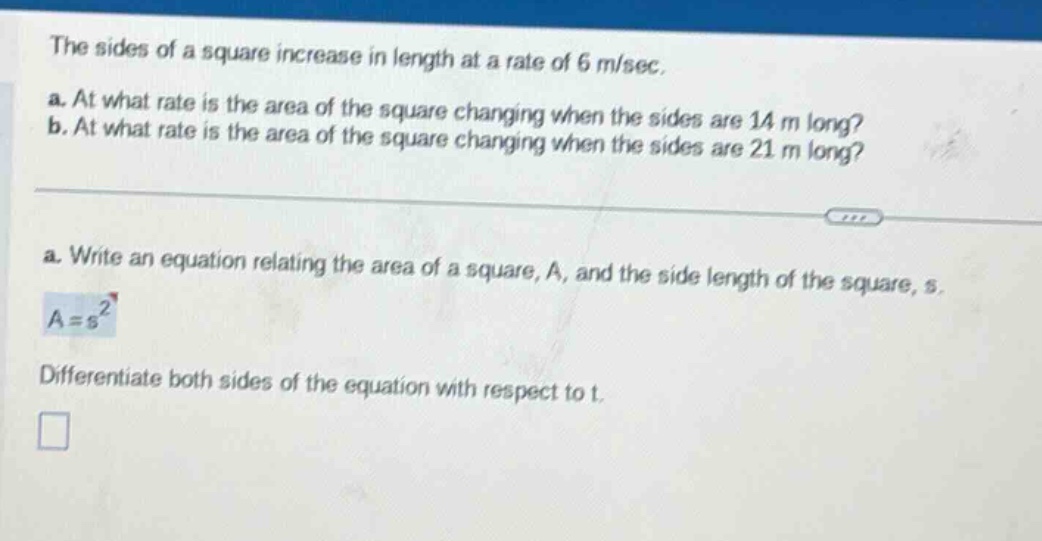
the sides of a square increase in length at a rate of 6 m/sec. a. at what rate is the area of the square changing when the sides are 14 m long? b. at what rate is the area of the square changing when the sides are 21 m long? a. write an equation relating the area of a square, a, and the side length of the square, s. a = s² differentiate both sides of the equation with respect to t.
Answer
Explanation:
Step1: Differentiate area formula
Differentiate $A = s^{2}$ with respect to $t$ using the chain - rule. $\frac{dA}{dt}=2s\frac{ds}{dt}$.
Step2: Solve part a
Given $\frac{ds}{dt}=6$ m/sec and $s = 14$ m. Substitute into $\frac{dA}{dt}=2s\frac{ds}{dt}$. $\frac{dA}{dt}=2\times14\times6=168$ m²/sec.
Step3: Solve part b
Given $\frac{ds}{dt}=6$ m/sec and $s = 21$ m. Substitute into $\frac{dA}{dt}=2s\frac{ds}{dt}$. $\frac{dA}{dt}=2\times21\times6 = 252$ m²/sec.
Answer:
a. 168 m²/sec b. 252 m²/sec