this is similar to a problem in the textbook.\n t (seconds) 0 2 4 6 8\n velocity (ft/sec) 0 4 12 24 36\n…
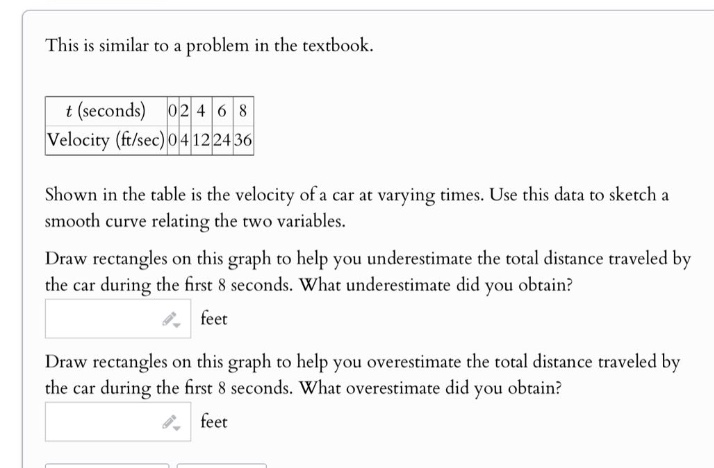
this is similar to a problem in the textbook.\n t (seconds) 0 2 4 6 8\n velocity (ft/sec) 0 4 12 24 36\n shown in the table is the velocity of a car at varying times. use this data to sketch a smooth curve relating the two variables.\n draw rectangles on this graph to help you underestimate the total distance traveled by the car during the first 8 seconds. what underestimate did you obtain?\n feet\n draw rectangles on this graph to help you overestimate the total distance traveled by the car during the first 8 seconds. what overestimate did you obtain?\n feet
Answer
Explanation:
Step1: Determine sub - interval width
The time interval is from (t = 0) to (t=8) seconds, and we will use sub - intervals of width (\Delta t=2) seconds.
Step2: Calculate underestimate
For the underestimate, we use the left - hand endpoints of each sub - interval. The velocities at (t = 0,2,4,6) are (v(0)=0), (v(2) = 4), (v(4)=12), (v(6)=24). The distance (d_{under}) is given by the sum of the products of the velocity at the left - hand endpoint and the sub - interval width. [d_{under}=\sum_{i = 0}^{3}v(t_i)\Delta t=0\times2 + 4\times2+12\times2 + 24\times2] [d_{under}=(0 + 4+12 + 24)\times2=(40)\times2 = 80]
Step3: Calculate overestimate
For the overestimate, we use the right - hand endpoints of each sub - interval. The velocities at (t = 2,4,6,8) are (v(2)=4), (v(4)=12), (v(6)=24), (v(8)=36). The distance (d_{over}) is given by the sum of the products of the velocity at the right - hand endpoint and the sub - interval width. [d_{over}=\sum_{i = 1}^{4}v(t_i)\Delta t=4\times2+12\times2 + 24\times2+36\times2] [d_{over}=(4 + 12+24 + 36)\times2=(76)\times2=152]
Answer:
Underestimate: 80 feet Overestimate: 152 feet