a simple model for travel costs involves the cost of gasoline and the cost of a driver. specifically, assume…
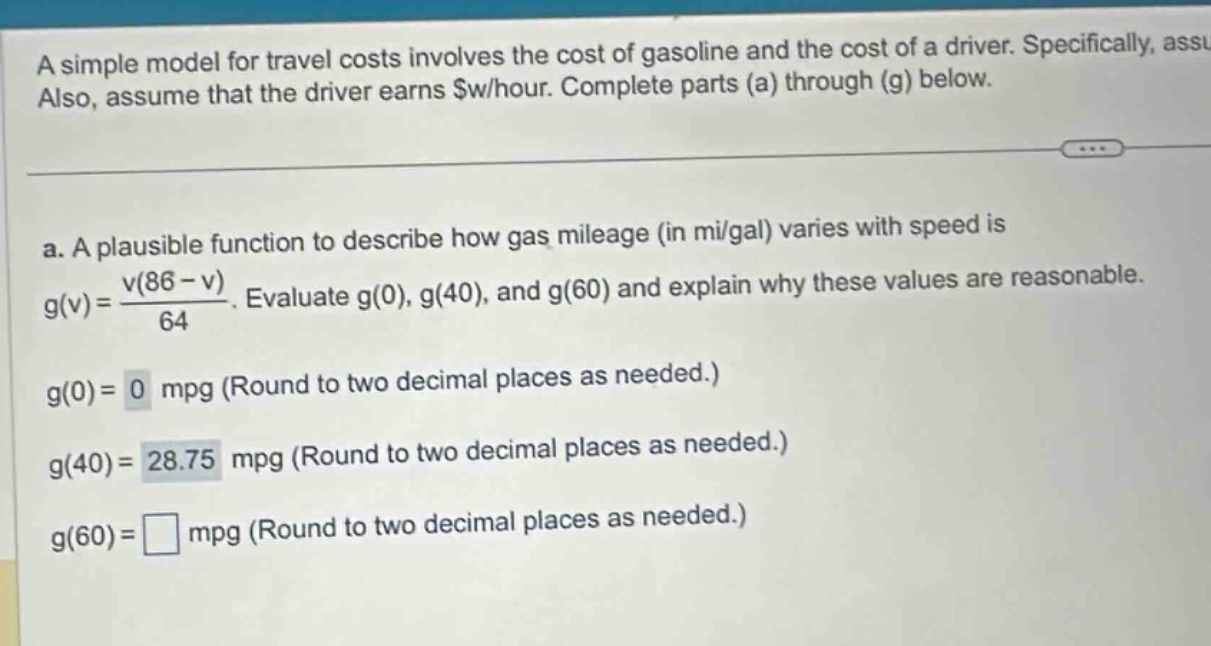
a simple model for travel costs involves the cost of gasoline and the cost of a driver. specifically, assume also, assume that the driver earns $w/hour. complete parts (a) through (g) below. a. a plausible function to describe how gas mileage (in mi/gal) varies with speed is g(v)=v(86 - v)/64. evaluate g(0), g(40), and g(60) and explain why these values are reasonable. g(0)=0 mpg (round to two decimal places as needed.) g(40)=28.75 mpg (round to two decimal places as needed.) g(60)=□ mpg (round to two decimal places as needed.)
Answer
Explanation:
Step1: Substitute v = 60 into the function
Substitute (v = 60) into (g(v)=\frac{v(86 - v)}{64}). [g(60)=\frac{60\times(86 - 60)}{64}]
Step2: Calculate the value inside the parentheses
First, calculate (86-60 = 26). Then the expression becomes (g(60)=\frac{60\times26}{64}).
Step3: Calculate the product in the numerator
Calculate (60\times26=1560). So (g(60)=\frac{1560}{64}).
Step4: Perform the division
(1560\div64 = 24.375), rounded to two - decimal places is (24.38).
Answer:
(24.38)