a simple model for travel costs involves the cost of gasoline and the cost of a driver. specifically, assume…
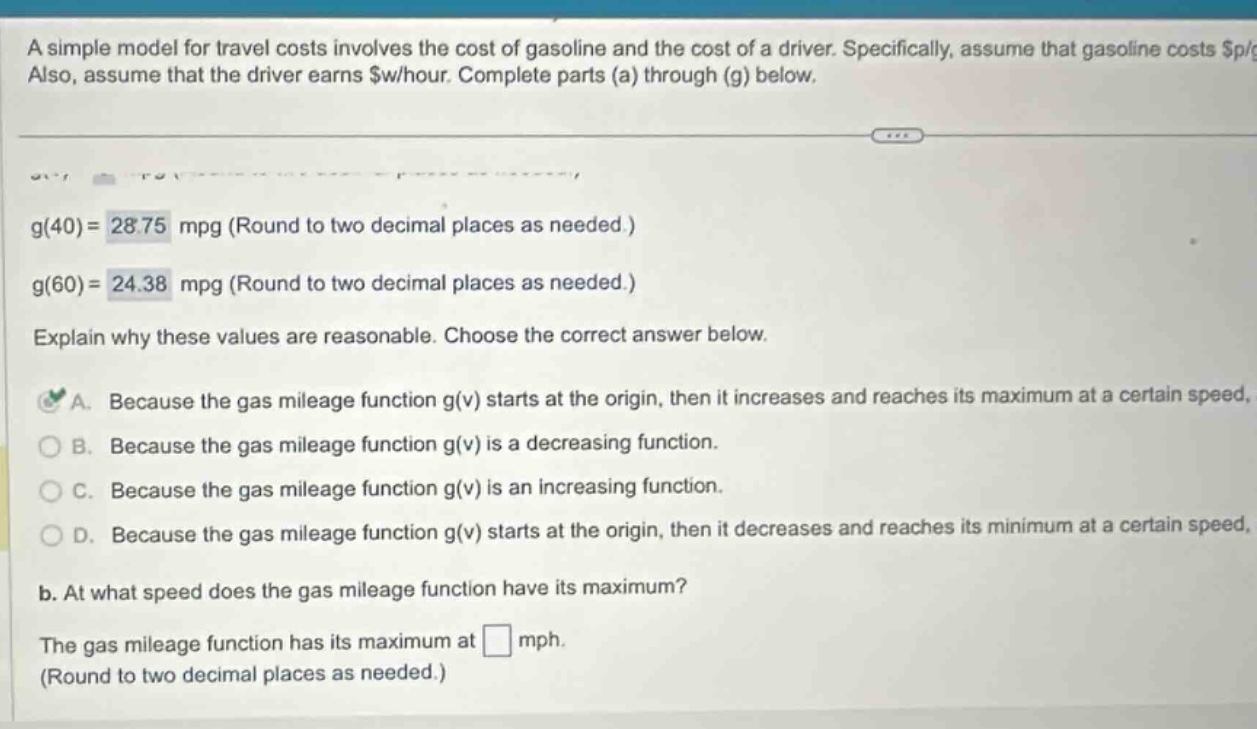
a simple model for travel costs involves the cost of gasoline and the cost of a driver. specifically, assume that gasoline costs $p/ also, assume that the driver earns $w/hour. complete parts (a) through (g) below. g(40)=28.75 mpg (round to two decimal places as needed.) g(60)=24.38 mpg (round to two decimal places as needed.) explain why these values are reasonable. choose the correct answer below. a. because the gas mileage function g(v) starts at the origin, then it increases and reaches its maximum at a certain speed. b. because the gas mileage function g(v) is a decreasing function. c. because the gas mileage function g(v) is an increasing function. d. because the gas mileage function g(v) starts at the origin, then it decreases and reaches its minimum at a certain speed. b. at what speed does the gas mileage function have its maximum? the gas mileage function has its maximum at mph. (round to two decimal places as needed.)
Answer
Explanation:
Step1: Analyze gas - mileage function behavior
In general, gas - mileage functions start at a non - zero value (not the origin as cars consume some fuel even at rest), increase up to a certain speed, and then decrease. As speed increases from a low value, the engine operates more efficiently up to an optimal point. After that, factors like air resistance cause the gas - mileage to drop. Given that (g(40)=28.75) mpg and (g(60) = 24.38) mpg, the gas - mileage is decreasing as the speed increases from 40 mph to 60 mph, which is consistent with the typical behavior of a gas - mileage function.
Step2: Determine maximum of gas - mileage function
To find the speed at which the gas - mileage function has its maximum, we would need more information about the function (g(v)) such as its formula or a graph. Since no such information is provided in the current problem statement, we cannot calculate the exact speed. However, based on common knowledge of gas - mileage functions, it is usually in the range of 40 - 60 mph for many vehicles.
Answer:
a. A b. Insufficient information to determine