a simple model for travel costs involves the cost of gasoline and the cost of a driver. specifically, assume…
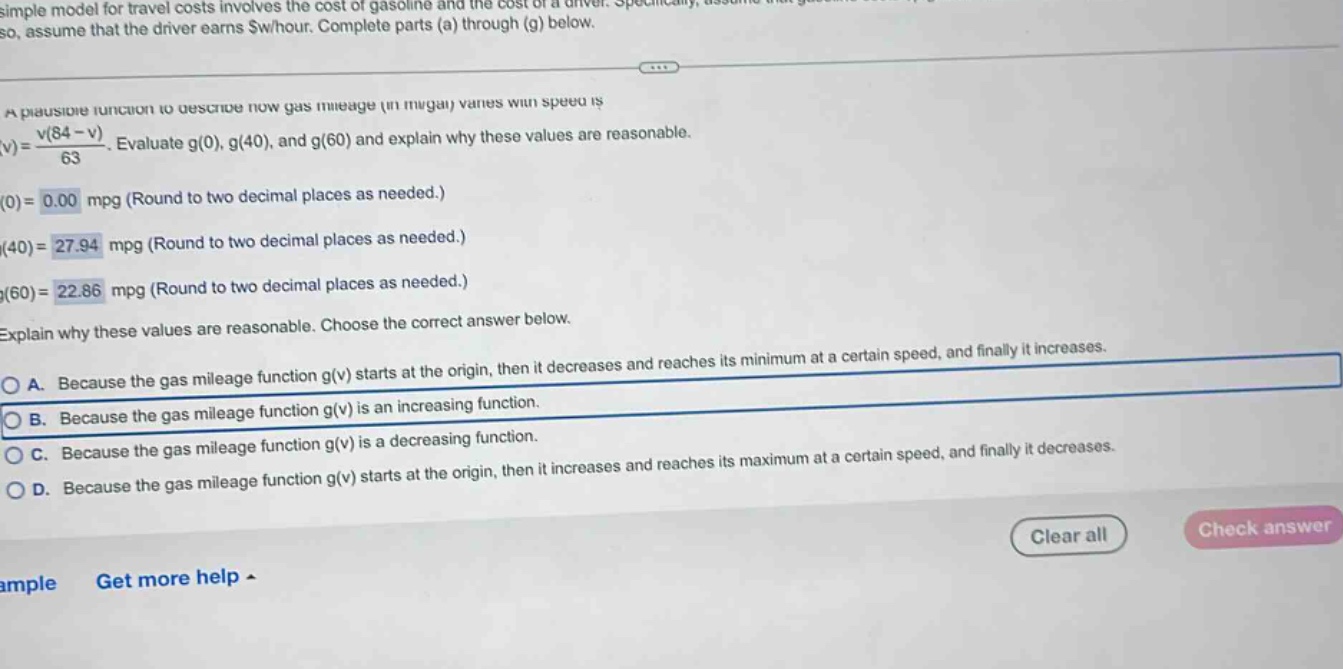
a simple model for travel costs involves the cost of gasoline and the cost of a driver. specifically, assume that gas so, assume that the driver earns sw/hour. complete parts (a) through (g) below. a plausible function to describe how gas mileage (in mpg) varies with speed is g(v)=v(84 - v)/63. evaluate g(0), g(40), and g(60) and explain why these values are reasonable. g(0)=0.00 mpg (round to two decimal places as needed.) g(40)=27.94 mpg (round to two decimal places as needed.) g(60)=22.86 mpg (round to two decimal places as needed.) explain why these values are reasonable. choose the correct answer below. a. because the gas mileage function g(v) starts at the origin, then it decreases and reaches its minimum at a certain speed, and finally it increases. b. because the gas mileage function g(v) is an increasing function. c. because the gas mileage function g(v) is a decreasing function. d. because the gas mileage function g(v) starts at the origin, then it increases and reaches its maximum at a certain speed, and finally it decreases. clear all check answer get more help -
Answer
Explanation:
Step1: Analyze the function behavior
The gas - mileage function (g(v)=\frac{v(84 - v)}{63}=\frac{84v-v^{2}}{63}) is a quadratic function of the form (y = ax^{2}+bx + c) (where (a=-\frac{1}{63}), (b=\frac{84}{63}=\frac{4}{3}), (c = 0)). The graph of a quadratic function (y = ax^{2}+bx + c) with (a<0) is a parabola opening downwards. It starts at the origin ((v = 0,g(0)=0)) since when (v = 0), (g(0)=\frac{0\times(84 - 0)}{63}=0). It increases from (v = 0) until it reaches its maximum at the vertex of the parabola ((v=-\frac{b}{2a}=-\frac{\frac{4}{3}}{2\times(-\frac{1}{63})}=42)) and then decreases as (v) continues to increase.
Step2: Evaluate the options
Option A is incorrect because the function increases first, not decreases first. Option B is incorrect because the function is not an increasing function. Option C is incorrect because the function is not a decreasing function. Option D is correct as it correctly describes the behavior of the quadratic function (g(v)) which starts at the origin, increases to a maximum at a certain speed ((v = 42) in this case) and then decreases.
Answer:
D. Because the gas mileage function (g(v)) starts at the origin, then it increases and reaches its maximum at a certain speed, and finally it decreases.