simplify the expression: give the answer in exact form. sin(arcsin(1/2)+arctan(-3))
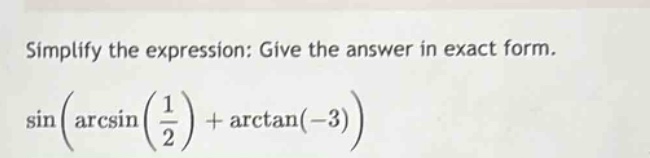
simplify the expression: give the answer in exact form. sin(arcsin(1/2)+arctan(-3))
Answer
Explanation:
Step1: Evaluate $\arcsin(\frac{1}{2})$
We know that $\arcsin(\frac{1}{2})=\frac{\pi}{6}$ since $\sin(\frac{\pi}{6})=\frac{1}{2}$ and the range of $y = \arcsin(x)$ is $[-\frac{\pi}{2},\frac{\pi}{2}]$.
Step2: Use the sum - formula for sine
The sum - formula for sine is $\sin(A + B)=\sin A\cos B+\cos A\sin B$. Here $A=\frac{\pi}{6}$ and $B = \arctan(-3)$. Let $\theta=\arctan(-3)$, then $\tan\theta=-3=\frac{\sin\theta}{\cos\theta}$, and $\sin^{2}\theta+\cos^{2}\theta = 1$. Since $\tan\theta=-3\lt0$, $\theta$ is in either the second or fourth quadrant. We have $\sin\theta=\frac{-3}{\sqrt{1 + (-3)^{2}}}=-\frac{3}{\sqrt{10}}$ and $\cos\theta=\frac{1}{\sqrt{10}}$ (because if $\tan\theta=\frac{y}{x}=-3$, we can consider a right - triangle with $y=-3$ and $x = 1$, and $r=\sqrt{x^{2}+y^{2}}=\sqrt{1 + 9}=\sqrt{10}$). Now, $\sin(A + B)=\sin(\frac{\pi}{6})\cos(\arctan(-3))+\cos(\frac{\pi}{6})\sin(\arctan(-3))$. We know that $\sin(\frac{\pi}{6})=\frac{1}{2}$, $\cos(\frac{\pi}{6})=\frac{\sqrt{3}}{2}$, $\cos(\arctan(-3))=\frac{1}{\sqrt{10}}$, and $\sin(\arctan(-3))=-\frac{3}{\sqrt{10}}$.
Step3: Substitute the values
$\sin(\frac{\pi}{6})\cos(\arctan(-3))+\cos(\frac{\pi}{6})\sin(\arctan(-3))=\frac{1}{2}\times\frac{1}{\sqrt{10}}+\frac{\sqrt{3}}{2}\times(-\frac{3}{\sqrt{10}})$ $=\frac{1 - 3\sqrt{3}}{2\sqrt{10}}=\frac{\sqrt{10}(1 - 3\sqrt{3})}{20}=\frac{\sqrt{10}-3\sqrt{30}}{20}$
Answer:
$\frac{\sqrt{10}-3\sqrt{30}}{20}$