simplify the expression: give the answer in exact form. tan(cos^(-1)(sqrt(3)/2) - sin^(-1)(-3/5)) 2.34105821…
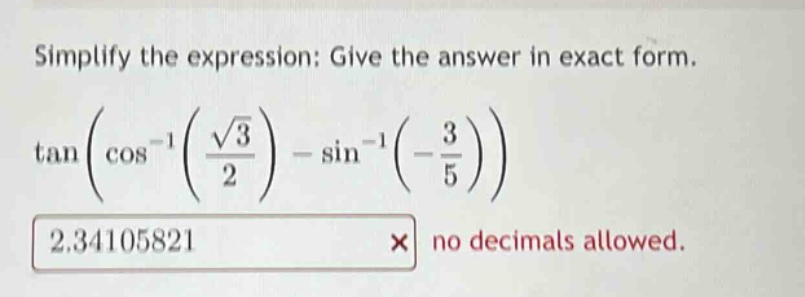
simplify the expression: give the answer in exact form. tan(cos^(-1)(sqrt(3)/2) - sin^(-1)(-3/5)) 2.34105821 × no decimals allowed.
Answer
Explanation:
Step1: Evaluate $\cos^{-1}(\frac{\sqrt{3}}{2})$
Let $\alpha=\cos^{-1}(\frac{\sqrt{3}}{2})$. Since $\cos\alpha=\frac{\sqrt{3}}{2}$ and $0\leq\alpha\leq\pi$, then $\alpha = \frac{\pi}{6}$.
Step2: Evaluate $\sin^{-1}(-\frac{3}{5})$
Let $\beta=\sin^{-1}(-\frac{3}{5})$. Then $\sin\beta=-\frac{3}{5}$ and $-\frac{\pi}{2}\leq\beta\leq\frac{\pi}{2}$. Using $\sin^{2}\beta+\cos^{2}\beta = 1$, we get $\cos\beta=\sqrt{1 - (-\frac{3}{5})^{2}}=\frac{4}{5}$ (because $\cos\beta>0$ for $-\frac{\pi}{2}\leq\beta\leq\frac{\pi}{2}$).
Step3: Use the tangent - difference formula $\tan(A - B)=\frac{\tan A-\tan B}{1 + \tan A\tan B}$
We know that $\tan\alpha=\tan(\frac{\pi}{6})=\frac{\sqrt{3}}{3}$ and $\tan\beta=\frac{\sin\beta}{\cos\beta}=-\frac{3}{4}$. Then $\tan(\alpha-\beta)=\frac{\frac{\sqrt{3}}{3}-(-\frac{3}{4})}{1+\frac{\sqrt{3}}{3}\times(-\frac{3}{4})}=\frac{\frac{\sqrt{3}}{3}+\frac{3}{4}}{1 - \frac{\sqrt{3}}{4}}=\frac{4\sqrt{3}+9}{12 - 3\sqrt{3}}$. Rationalize the denominator: Multiply the numerator and denominator by $12 + 3\sqrt{3}$. [ \begin{align*} &\frac{(4\sqrt{3}+9)(12 + 3\sqrt{3})}{(12 - 3\sqrt{3})(12 + 3\sqrt{3})}\ =&\frac{48\sqrt{3}+36 + 108+27\sqrt{3}}{144-27}\ =&\frac{75\sqrt{3}+144}{117}\ =&\frac{25\sqrt{3}+48}{39} \end{align*} ]
Answer:
$\frac{25\sqrt{3}+48}{39}$